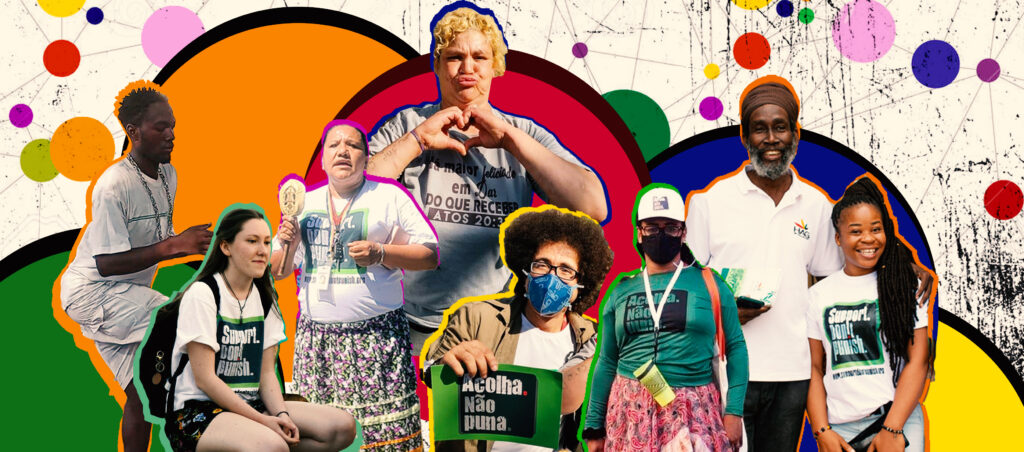
Gesturing to What is Possible: Drugs Users Supporting Each Other
Peter Krykant Aura Roig Juan Fernández Ochoa
Rather than asking the state for services, what kinds of change are made possible when we prioritise people supporting each other?
Arika have been creating events since 2001. The Archive is space to share the documentation of our work, over 600 events from the past 20 years. Browse the archive by event, artists and collections, explore using theme pairs, or use the index for a comprehensive overview.
Rather than asking the state for services, what kinds of change are made possible when we prioritise people supporting each other?
In this workshop we will imagine ourselves as time travellers from a glorious and chaotic neurodivergent-led future.
Austrian guitarist who specialises in a warm digital deconstruction of guitar noise
Quartet improvisation by Klaus Filip – laptop, Radu Malfatti – trombone, Sean Meehan – snare & cymbals, Taku Unami – rice and dish.
Solo performance by Diamanda Galás one of the great artists of the last forty years. Hers is an emotional expressionism of demonic shrieks, operatic falsettos, glottal clicks and diabolical growls.
In the Foyer at the Tramway we will screen a documentary from the Sex Workers’ Festival of Resistance 2017 and La Llamada by Eduardo Restrepo Castaño.
A day of presentations and discussions on the theme of audio visual perception in the context of experimental music, film and art.
Criminal Queers visualises a radical trans/queer struggle against the prison industrial complex, working to abolish the multiple ways our hearts, genders, and desires are confined.
Databases carry the same seeds of creativity that early documentary makers saw in film. Both can empower people by helping them to master information, both can be claimed to represent some kind of reality or truth.
Ellis’s processional, precessional cessation and continuation of movement and music comes to us via his forthcoming release Aster of Ceremonies (Milkweed Editions, 2023)
An improvisation that may or may not involve (typical) improvisation.
How do you know what you want? Should freedom be doing what you ought, not doing what you want? How might a philosopher and artist turn this thinking into an enabling condition in the context of noise and improvisation?