Toward a Sumudic Cinema
Toward a Sumudic Cinema
Michel Khleifi is widely considered one of the founders of contemporary Palestinian cinema. In conversation with Ayreen Anastas and Rene Gabri, he’ll screen his landmark documentary of anti-colonial time and persistence, Ma’loul Celebrates its Destruction.
Drawing from Ma’loul and hand selected scenes from some of Michel’s other remarkable films including the landmark feature Fertile Memory; the three will try to collectively map some characteristics of what they would like to theorise as sumudic cinema. That is, a cinema which remains steadfast in resisting not only the programmed obliteration and oblivion which Nakba names, but also the imbrication of film, art to future its regime.
Overview
Any of Michel’s films would have been perfect for Episode 12. In the end, we decided to focus on Ma’loul Celebrates its Destruction, as it speaks to so many of the thematics in Episode 12: memory, the rejection of colonial time and permanence, everyday life as the source of history…
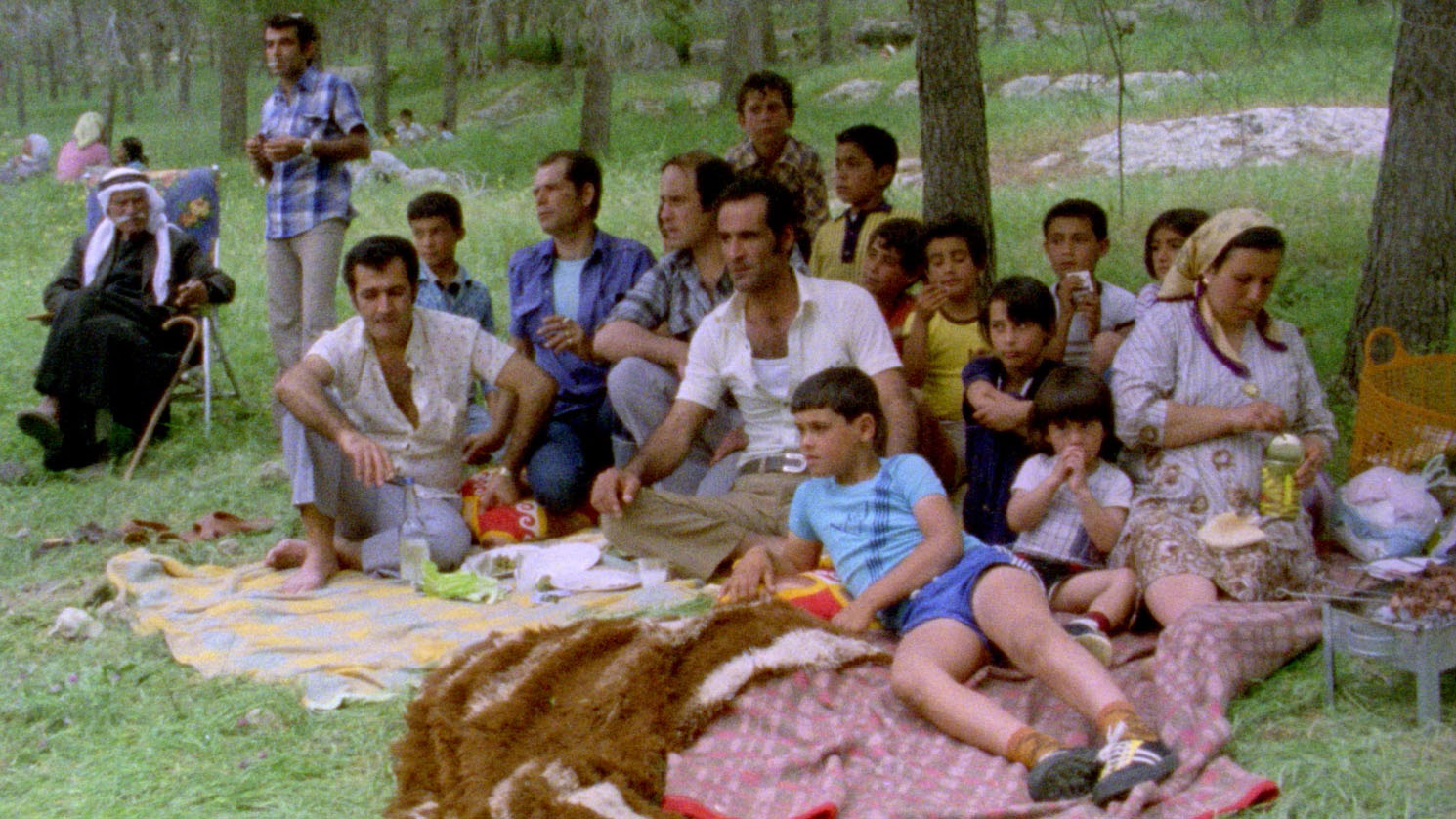
In 1948, the people of Ma’Loul were forced from their village, all but its churches and mosque destroyed, and their land seized in their so-called ‘absence’. Perversely, the only time they can now safely visit their village is on ‘Independence Day’, the day the Israeli state celebrates its founding. To deepen the wound, a forest has been planted by the dispossessing state, over their destroyed village in the name of victims of Nazi genocide. These colonial memory practices of ‘celebration’ and ‘commemoration’ are turned upside down by the people of Ma’loul. By returning every year to their village, they practice a resistance to the idea of colonisation as permanent and reverse a state imposed amnesia of the mass crime into an anti-denialist praxis of re-membering. Through this and other remarkable moments recorded by Khleifi, the film pays homage to a community’s steadfast refusal to take part in a temporalization and historiography which celebrates and envisages their own destruction.
Michel, Ayreen and Rene will introduce the film and afterward, try through the sharing of excerpts from his other seminal works, to open a space to collectively perceive what Palestinian’s refer to as sumud (steadfastness). Here, considered not only as an everyday political praxis but also, potentially as a critical means of outliving genocidal culture.
Context
Settler colonialism proposes a radical presentism—that we should move beyond historical injustices or any idea of anti-colonial redress. The people of Ma’Loul practice a material refusal of this lie: they live in different presents simultaneously, a kind of contemporaneous non-contemporaneity that unsettles settler colonialism claim to have moved beyond the past. This is exactly the kind of counter temporality that Nasser Abourahme and Peter Mahklouf will talk about on Sunday. It is also maybe a Palestinian analogue to Leda Maria Martins’ discussion The Curved Time of Memory about Afro-Brazilian time as recurring and spiral; one that circles back, restores, and transforms.
Films
Ma’Loul Celebrates its Destruction
Ma’loul is a Palestinian village in the Galilee which was, as part of Operation Dekel, destroyed by Zionist military forces in July of 1948. Its inhabitants were forcibly driven out and their homes, lands expropriated. All that remains of the village are two churches and a mosque, the last visible traces for travellers between Haifa and Nazareth. Over the years, they too disappeared, under a forest planted in memory of the victims of Nazism. The Zionist forces and later their state, in this way, wiped off the map over 400 Palestinian villages. But the former inhabitants of Ma’loul have created a new tradition: that of going for a picnic one day a year on the site of their destroyed village, paradoxically on the day of the independence of the State of Israel. It is the day of the picnic that we filmed; the encounter with a stone, a window, a wall, an olive or a pomegranate tree… hidden under the woods. A peasant notes among the young pines certain uncertain landmarks of his lost universe. A family comments with a pureness of heart on the mural fresco of their village, painted according to traces from their memory. As required by the official Israeli curriculum, a teacher explains to his ‘Arab’ students, officially denied of their Palestinian identity, the history of the creation of the State of Israel. These elements of reality that confront each other and compose the film allow us to underline a critical dimension to the ongoing resistance to the Nakba: that of our relations to time.
Fertile Memory (among the films from which selections will be shared)
(Al Dhakira al Khasba)
A film by Michel Khleifi
Rejecting both the sterile formulas of state or corporate imposed fictions as entertainment or denials masquerading as objectivity, documentary, Michel Khleifi’s seminal essay film is a radical meditation on indigenous womens’ constancy and memory as an anti-colonial weapon. Filmed within the fractured geography of Palestine, the film bypasses Western abstractions such as ‘nationalism’ to make tangible, through the lives of two Palestinian women and the worlds around them, an insistence on and persistence of an outside to the settler-colony’s past, present, future.
Rather than framing its subjects through a simplistic binary of “tradition versus modernity,” the film charts two distinct, uncompromising trajectories of resistance to elimination and effacement.
Roumieh Farah Hatoum, Khleifi’s aunt, a widow living in Yafa an-Naseriye (Jaffa of Nazareth), mounts a profound critique of settler-colonial capitalism. Though her family’s ancestral land has been expropriated by the Zionist state and she is forced to sell her labor to a textile factory, she obstinately refuses to accept financial compensation. By denying the state a legal receipt for its theft, Farah’s steadfast presence on the land becomes an unyielding roadblock to colonial foreclosure. Her memory is an active, furtive refusal to accept the emptying and exchanging of time, of fertile memory for anything other than justice.
Sahar Khalifeh, a novelist from Nablus living in Ramallah, wages a struggle for intellectual and psychological autonomy. For Sahar, the act of thinking her condition, women’s condition, the Palestinians condition, through writing is not a departure from the struggle, but at its core; settler-colonialism demands the psychological erasure of the colonized, and her insistence on female consciousness, of desire, and intellectual autonomy directly defies the colonial attempt to reduce Palestinian life to a flat image of a subjugated victim.
Through a lyrical blending of framed realities and staged vignettes, Fertile Memory underlines the recurring rhythms of women’s labors and everyday reproduction, material and cultural, as the basis of an ongoing potent political practice. Here the image of the resistance fighter is re-visioned through women, refusing to reconcile with the ongoing injustices, reproducing life and a narration of it, in their own terms, proving that the most radical anti-colonial act is the constant reclamation of that life beyond the colony’s settlements.
ReadBios
Born in Nazareth in 1950 to a Palestinian working-class family, Michel Khleifi is considered the founder of contemporary Palestinian cinema and one of its most original voices. After immigrating to Belgium in 1970, he studied theatre and television at INSAS, Brussels and worked for RTBF (Belgian television) before making his first feature‐length documentary, Fertile Memory (1980), which combined a lyrical aesthetic with a critical political engagement, as did Maloul Celebrates its Destruction (1985).
In 1987, he directed Wedding in Galilee, the first feature film entirely shot in Palestine by a Palestinian director, which premiered at the Cannes Directors’ Fortnight and won the International Critics Prize among many other awards. The film marked Palestinian cinema’s entry into the international scene. A further three features followed: Canticle of the Stones (1990), L’ordre du jour (1992) and Tale of the Three Jewels (1995), and documentaries Forbidden Marriages in the Holy Land (1996) and Route 181 – Fragments of a Journey in Palestine and Israel (2002, co‐directed with Eyal Sivan). Zindeeq (2009) won the Golden Muhr at the 2009 Dubai International Film Festival. Khleifi lives in Brussels, where he has taught filmmaking at INSAS for over thirty years, in addition to other teaching posts at Columbia University, St Joseph University in Beirut and AM Qattan Foundation in Palestine and Jordan.
Ayreen Anastas, a body in search of gestures, words, phrases, sentences to disactivate and destitute the impositions, forms, including the form of biography this form of self, to bring about some forces which give potency to life to bodies with and around them. How to not separate one ‘self?’ from a common that helps shape life and gives it intensity and meaning. How to become unintelligible, incomprehensible, opaque to the fabricated machines of subjectivation and self-making. How to write in a language that only friends-to-come receive, a language that wrestles with language to keep the relations to all the palestines and to their forms of life alive.
Rene Gabri is another name for that process of recovering stolen life. The name is not gendered, though it has engendered enough confusion to assign to it all sorts of pronouns and prescriptions. It is a non-native name calling forth a native life, a life constantly pushed to the margins of oblivion. It recalls sites of previous and ongoing battles. It remains steadfastly associated with the wind, which is the closest kin or resembling a homeland. In this searching, a question which re-emerges: is wind origin, destiny or the unforeseen push toward a dissemination of the seeds of whatever could become recovery.
Access
BSL
Live Captions
Film with English Subtitles
See general Access information for Episode 12: From the Rivers to the Seas event
Artists
Michel Khleifi

Ayreen Anastas
