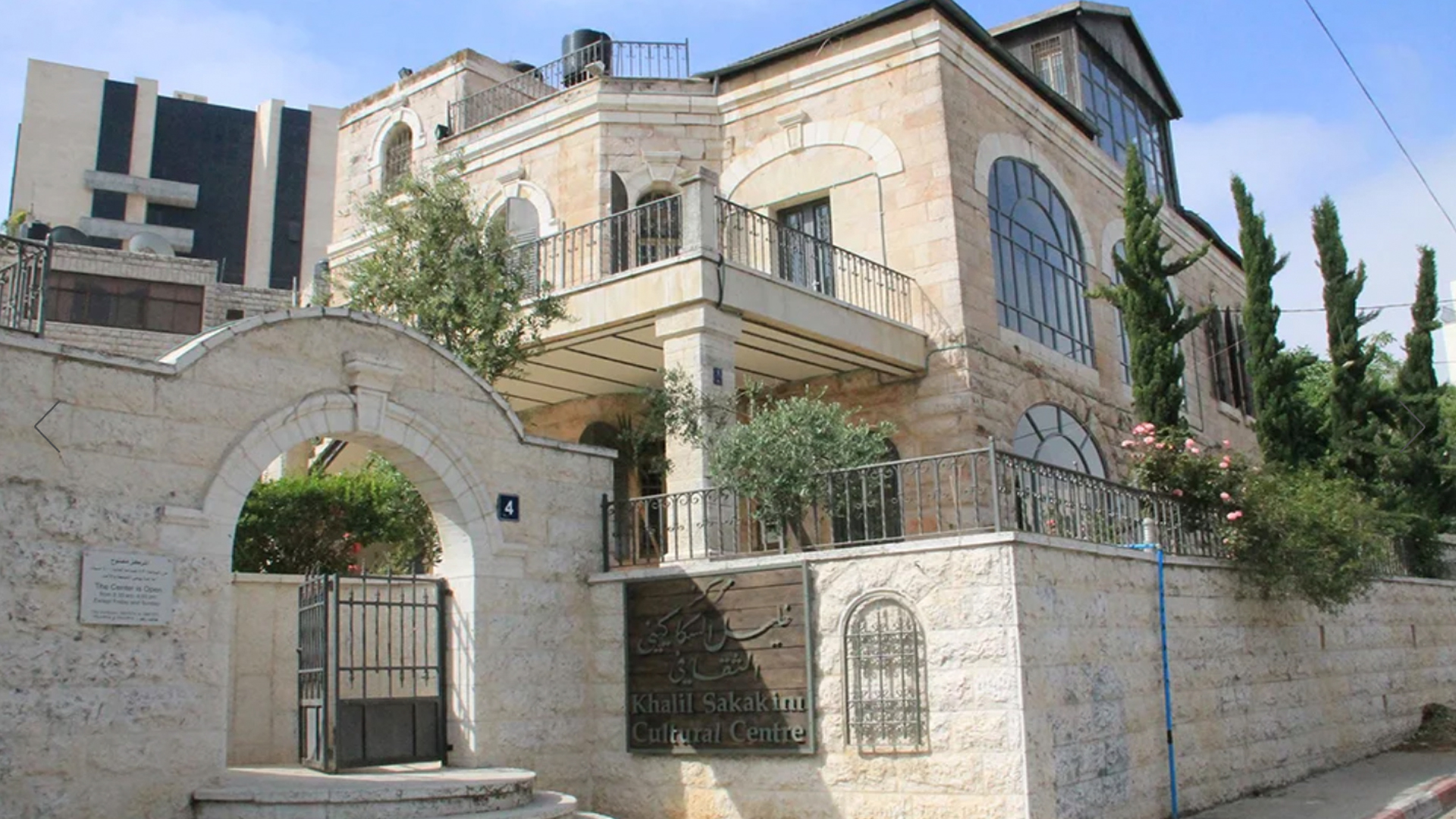
Khalil Sakakini Cultural Center Collaboration
Khalil Sakakini Cultural Center Collaboration
Summary
Connecting with friends in Palestine, in spite of the borders, states, infrastructured violence that tried to keep us apart, friends assembling in Ramallah will contribute online to The Conference of Butterflies, and organise their own mini-Episode in person.
Overview
Based in Ramallah, the Khalil Sakakini Cultural Center is one of the leading cultural institutions in Palestine, It hosts a multitude of events including art exhibitions, festivals, performances, concerts, talks, film screenings, and poetry readings. Incredibly, it is also where Mahmoud Darwish had his office for the last decade of his life: the office is maintained as it was by the centre to this day.
Thurs 12 – Khalil Sakakini Cultural Center Collaboration 1
Time:12:30 – 20:00 EET
The Conference of Butterflies, organised by the Anti-Denialist Museum of Palestine in person at the Episode, will be streamed live at the Sakakini Centre, where people will gather to follow and contribute to the day’s conversations. The Conference is in four movements, and the third movement, from 2:45 – 4:15, will be focused on our friends joining us virtually from Ramallah and potentially others parts of Palestine. This will include a conversation with Amirah Silmi, who was unable to join us in person in Glasgow due to the hostile nature of the border and visa process.
The conference will be translated into Arabic for those joining in Ramallah. Food will be served. There will be a small free publication in Arabic sharing details of the conference, and contextual information, available on the day. See here [https://arika.org.uk/a-conference-of-butterflies/] for the full information on the conference.
The colonisation of Palestine was and is still necessitated by capitalist, imperialist and fascist interests and considerations. But the struggle in Palestine is not a reactionary one, it does not seek its own fascism, rather the freedom struggle in Palestine is an anti-capitalist struggle, and as thus it is not a struggle for a nation state, Palestine cannot be a nation state, Israel is, Palestine is the liberation of the world from nation states, from capitalism, even when capitalism has deceived itself into believing that it won the world decades ago. The Palestinians in their fight for Palestine resist uprootedness, they fight for a land, a right and a life, and these exceed the nation state. Amirah Silmi
This quote from Amriah, and her contribution online to Episode 11 helped us come to the title for this Episode–From The Rivers To The Seas–which we hope in its call for liberation to happen between every river and every sea, echoes Amirah’s call for Palestine to index the liberation of the world from nation states and borders.
Thurs 19th – Khalil Sakakini Cultural Center Collaboration 2
Time: 17:00 – 20:00 EET
Responding to local contexts and socialities and the best times to gather, instead of gathering to live stream specific parts of the Episode, Sakakini will organise a second gathering, on the Thursday after the Episode in Glasgow. At this, they will present a recording of Ayreen Anastas and Rene Gabri’s live/ unmade film The Nakba in the Room, which will be performed on Wed 11th in Glasgow. They will also screen Michel Khleifi’s Ma’loul Celebrates Its Destruction. And Michel, Rene and Ayreen will join people in Ramallah online, for a conversation about the two works and notions toward a sumudic cinema.
The works will be screened in Arabic or have translation. Food will be served.
The Nakba in the Room
Where has art stood in the Nakba’s perpetration? The Nakba in the Room is a film whose form is part of a response and a search for an exit from complicity; improvised, wrestled and unmade in the same time of its viewing by two of the most brilliant film performance makers we’ve worked with.
A few bodies enter a room. They begin by acknowledging the Nakba is there in that room and they try to understand, within the means of the cinematic space time, in the presence of other fleshly creatures, who have joined them, giving their time, energy, attention, to consider whether together, from where they are situated and in resistance to an ongoing genocide in Palestine, stretching across the region and the planet, they can rehearse the conditions for an art which can wrestle with and out of its complicities, imbrications in reproducing the genocidal culture futuring the Nakba.
Ma’loul Celebrates its Destruction
Michel Khleifi is widely considered one of the founders of contemporary Palestinian cinema. In conversation with Ayreen Anastas and Rene Gabri, he’ll screen his landmark documentary of anti-colonial time and persistence, Ma’loul Celebrates its Destruction. Ma’loul is a Palestinian village in the Galilee which was, as part of Operation Dekel, destroyed by Zionist military forces in July of 1948. Its inhabitants were forcibly driven out and their homes, lands expropriated. All that remains of the village are two churches and a mosque, the last visible traces for travellers between Haifa and Nazareth. Over the years, they too disappeared, under a forest planted in memory of the victims of Nazism. The Zionist forces and later their state, in this way, wiped off the map over 400 Palestinian villages. But the former inhabitants of Ma’loul have created a new tradition: that of going for a picnic one day a year on the site of their destroyed village, paradoxically on the day of the independence of the State of Israel. It is the day of the picnic that we filmed; the encounter with a stone, a window, a wall, an olive or a pomegranate tree… hidden under the woods. A peasant notes among the young pines certain uncertain landmarks of his lost universe. A family comments with a pureness of heart on the mural fresco of their village, painted according to traces from their memory. As required by the official Israeli curriculum, a teacher explains to his ‘Arab’ students, officially denied of their Palestinian identity, the history of the creation of the State of Israel. These elements of reality that confront each other and compose the film allow us to underline a critical dimension to the ongoing resistance to the Nakba: that of our relations to time.
More info on the film and the conversation around it at the Episode can be found here – Toward a Sumudic Cinema.
ReadBios
Khalil Sakakini Cultural Center (KSCC)
Founded in 1996, the Khalil Sakakini Cultural Centre is one of Palestine’s leading independent cultural institutions, located in Ramallah. It is housed in a renovated building dating back to the early 20th century, renowned for its traditional Palestinian architecture. The center was named after the Jerusalemite scholar and writer Khalil Sakakini (1878 – 1953).Over the past three decades, it has hosted a multitude of events including art exhibitions, festivals, performances, concerts, film screenings, and poetry readings. It has gained a strong reputation, locally and nationally, as a vibrant arts and culture organization, especially in the field of visual arts, where the primary focus has been on nurturing new talents. Today, the centre is known as an institution that celebrates art for its capacity to question; to pose alternative ways of thinking, perceiving and viewing; and to accommodate multiple interpretations that foster the values of critique and analysis. Our work focuses on art, literature, ecology, critical dialogue, and hosting community events.
Artists

Rene Gabri

Ayreen Anastas
Michel Khleifi
