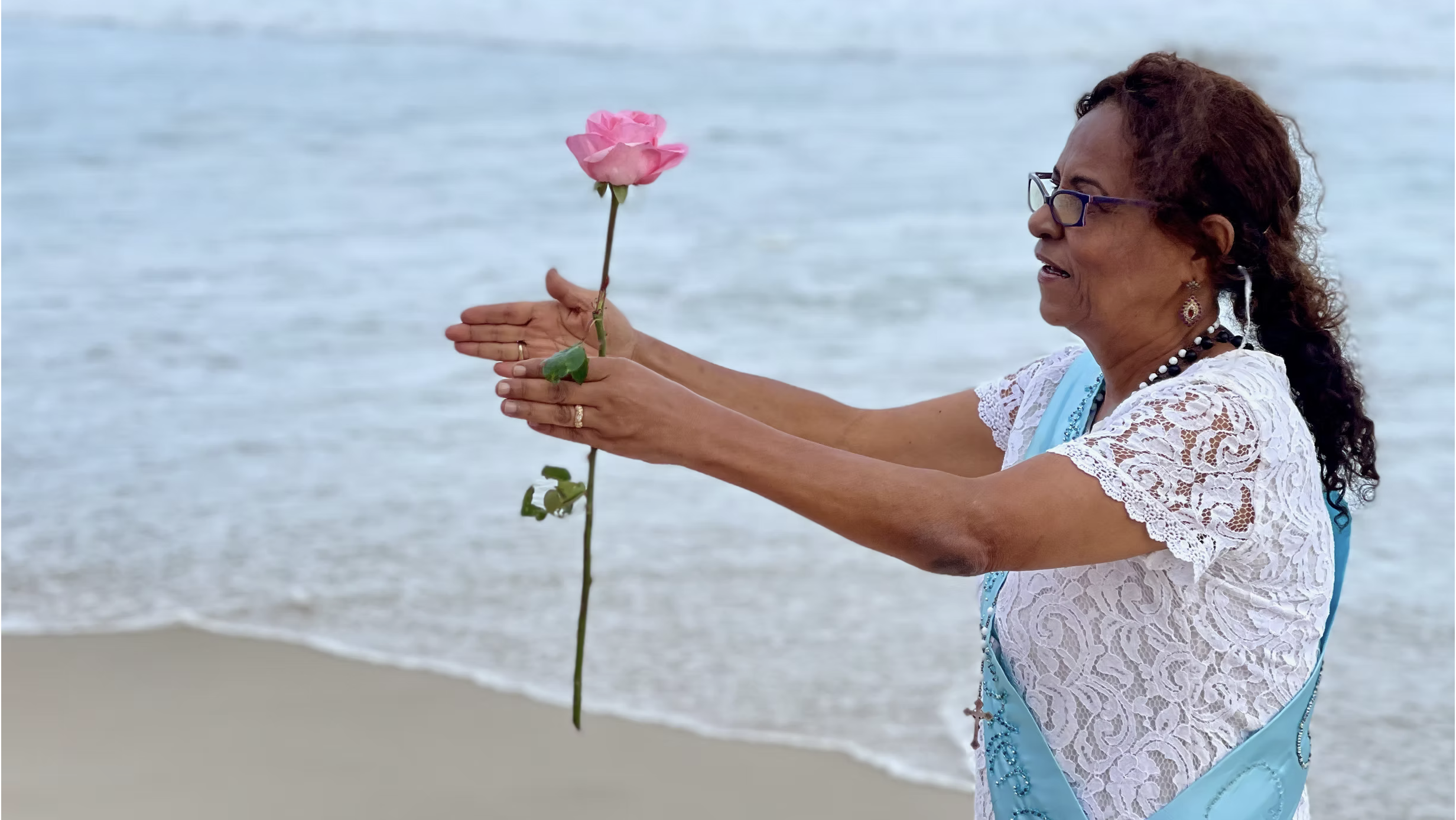
The Curved Time of Memory
The Curved Time of Memory
Leda’s philosophical writing and thinking is foundational to practices of theatre, performance, and dance in Brazil. In this conversation she’s joined by curator, writer and researcher Pelumi Odubanjo to discuss the breadth of her thinking – a host of concepts drawn from Afro-Brazilian experience, worldmaking and religious frameworks – and how these ideas relate to her understanding of performance within Black life.
Overview
We were lucky enough to spend an afternoon with Leda in São Paulo earlier this year, for a conversation unlike any presentation of philosophical ideas we’ve ever experienced. Through song, dance and interlinked and unfolding poetic conversation, Leda mapped out some of the key ideas she has crystalised from the life making practices of Afro-Brazilian religions Candomblé, Umbanda and Reinado—within which Leda has held the position Queen of Our Lady of Mercy in the Brotherhood of Our Lady of the Rosary of Jatobá, in Belo Horizonte.
Leda’s thinking is particularly interesting to us in relation to many of the friends who have contributed to past Episodes around practices of Blackness, especially Fred Moten (who writes the intro to Leda’s only book in English—Performances in Spiral Time) Denise Ferreira da Silva, who along with Amilcar Packer introduced us to Leda, Hortense Spillers and Nathaniel Mackey. Together they share an interest in thinking against separability; where a body or a person is not individuated, but rather a system of systems, an open set of differences or (as maybe Octavia Butler might write), a pattern of patterns. Like them, Leda insists on practices that resist systems of fixation and categorisation; constant fusions and transformations, confluences and deviations, ruptures and relations against purity, essentialism, and unchanging truths.
We’re excited to bring Pelumi and Leda together for this conversation, Leda’s idea of Afrographies maps how Black Yoruban lifeways changed as they interacted with Indigenous and Colonial ways of being in the Americas, to produce Afro-Brazilian thought. Pelumi, who is Nigerian and of Yoruba lineage, is currently researching what happens when these practices and forms travel back across the Atlantic to Nigeria – through language, cultural expression and images – returning differently to the places from which they first departed and their histories emerged.
Leda’s understanding of time as a “spiral”, countering colonial ideas of time as linear progression, has been foundational to Pelumi’s research and curatorial practice. More broadly, Leda’s expansive vocabulary offers Pelumi ways of thinking about circulation, return and transformation, and about the poetics and grammars through which African and Afro-Brazilian life continually remake themselves across time and geography.
CONTEXT
Some of the key ideas Leda has developed include:
‘Spiral Time’ names Leda’s understanding of an Afro-Brazilian anti-colonial temporality; a dynamic practice that is not linear and progressive, but which simultaneously curves backward and forward, in processes of recurring becoming and continuous movements that scramble and dissolve Western ideas of progress, past and future, cause and effect. “I am because I was and re-was before, and that I will be and re-be again.”
The ‘crossroads’ is a theoretical, conceptual, and methodological notion, capable of dealing with the confluences, transits, and multiple contagions present in Afro-diasporic, Afro-Brazilian, and Afro-American theatricalities. The crossroads is a meeting point of creation and enunciation whose principle is communication, movement, interpretation, translation, and metamorphosis. Thinking about the crossroads is a way to escape the (Western) trap of purity and to deal with porosity and impurities.
‘Oralaliture’ frames a multiplicity of embodied/ incorporated/ bodily knowledges (sounds, visualities, vocalizations, gestures, words, songs, rites, performances, dances) as ways of preserving ancestral knowledge, not through the printed word and the alphabet, but through the memory of the body. And in their embodiment, they are capable of resisting the multiple forms of colonization and annihilation of African bodies and knowledges.
‘Afrographies’ names the ways in which Afro-Brazilian identity has been woven by the interaction of diasporic lifeways with all the forms of social organization and symbolization of reality that they came into contact with; a fabric and a texture, choreographing Black singularities and otherness.
‘Patchwork Aesthetics’ describes the weaving of diverse textures in Black performing arts, where fragments, leftovers, remnants and residues are stitched together with movement, voice, bodies, texts and images to re-signify through juxtaposition.
ReadBIOS
Leda Maria Martins is one of the leading figures in contemporary Brazilian thought. She is a writer, poet, essayist, playwright, curator, art critic, researcher, and retired professor from the Federal University of Minas Gerais (UFMG). Since 2005, she has held the position of Queen of Our Lady of Mercy in the Brotherhood of Our Lady of the Rosary of Jatobá, in Belo Horizonte.
Since the late 1970s, Leda Maria Martins has been developing an intense body of theoretical work that has made essential contributions to thinking about the arts, especially theater, performance, and cultural manifestations such as the Reinado (a traditional Brazilian folk dance). Some of the concepts developed by the researcher, such as black theater, crossroads, Afrographies, orality, spiral time, patchwork aesthetics, and body-canvas, are theoretical, philosophical, poetic, and political keys built from intense reflection and the incessant search for conceptual and epistemological frameworks capable of proposing theoretical alternatives to the hegemony of white and Western thought.
Her theoretical production as a Black intellectual marks, in this sense, an important turning point in Brazilian thought and its historical dependence on European thought. From her doctoral thesis, defended in 1991 at the Faculty of Letters of UFMG, to the publication of her most recent book, Performances of Spiral Time, Poetics of the Body-Screen, in 2021, Leda Maria Martins has been constructing a dense conceptual arc based on the investigation of different philosophies and cosmo-perceptions, intertwining various aesthetics and epistemologies, from the most traditional to the most contemporary.
In 2017, she was honored with the creation of the Leda Maria Martins Award for Black Performing Arts, created by BDMG Cultural in recognition of her contribution to the field of Black Performing Arts, and in 2022 she was awarded the Milu Villela Prize, granted by Itaú Cultural, in the Learning category. In 2023 she was awarded the FUNARTE Master of Integrated Arts Prize. In 2023, her work was one of the foundations of the curatorial project of the 35th São Paulo Biennial. In 2024 and 2025 she was honored with the Leda Maria Martins Occupation by Itaú Cultural, in São Paulo. Also in 2025, the book Performances of Spiral Time was published by Duke University Press. In 2026, she received the Shell Theatre Award in the “Energy that comes from within” category for her decisive contribution to the appreciation of Afro-diasporic performances, articulating academic production, artistic practice, and social commitment.
Pelumi Odubanjo is a curator, writer and researcher based between Glasgow and London. She is a PhD candidate in History of Art at the University of Glasgow. Her doctoral research develops the concept of the Black Vernacular Image, thinking through the circulation, transformation and social lives of images across the Black Atlantic, with a particular focus on Brazil and Nigeria. Her wider curatorial and writing practice is concerned with photography, contemporary art and Black visual cultures, and with questions of memory, migration, movement and the afterlives of images.
She is Curator at Glasgow International Festival of Contemporary Art and she recently curated Ten.8 afterimage at The New Art Gallery Walsall, exploring the histories and continuing influence of the British photography journal Ten.8.
Access
BSL
Live Captions
Content Note
Discussion of anti-blackness, colonisation, and the slave trade.
See general Access information for Episode 12: From the Rivers to the Seas event
Artists
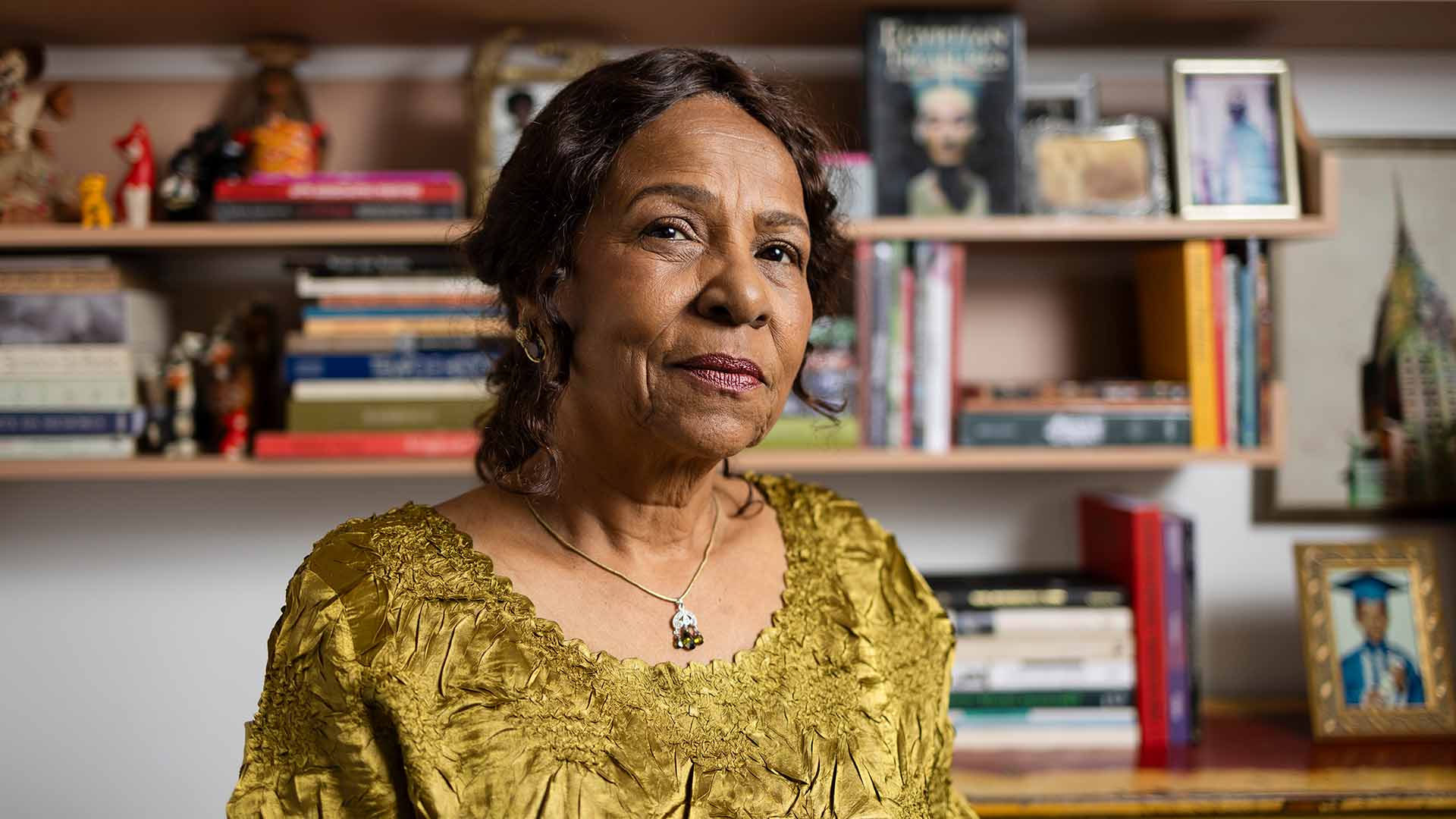
Leda Maria Martins