Teat(r)o Oficina – power of Presence in the presence of Power
Teat(r)o Oficina – power of Presence in the presence of Power
Fernanda Taddei works at Teat(r)o Oficina, as an actress, co-director, project conceiver and free passionate researcher since 2015. Oficina is the longest-running theater and company in Brazil; and has made major contributions to the formation and history not only of the performing arts, but culture in Brazil in its broadest sense. In this event, hosted with our friends at Take Me Somewhere, Fernanda will join us to share some of the history and approaches from Oficina’s world important radical theatre practice.
OVERVIEW
Oficina has developed a host of approaches, tools and ways of being that contribute to its ongoing experimental practice of resistance and counter-colonial aesthetics. Their performances are rites in which the distinction between the individual and the chorus is constantly dissolved and remade. Tragedy becomes a horizon of organising, in which persecution, violence and even the 500 year colonial legacy of Brazil are things that can be overcome in the here and now. By combining the Brazilian cultural notion of anthropophagy (cultural cannibalism: devouring of the other) with group improvisation, their performances, especially under founding director Ze Celso, became a means to find in the body a collective lysergic way of wanting.
CONTEXT
We visited Oficina in March this year: a visit which brought some of us to tears. It has a long and complex history, and is a major part of the cultural landscape of Brazil, which we couldn’t possibly explain in full. Instead, below are some notes on what they shared with us then:
Housed in the neighbourhood of Bixiga in São Paulo, Teat(r)o Oficina is one of the most influential radical theatre companies in the world. They were one of the foundational theatre companies to engage with the Brazilian anti-colonial understanding of anthropophagy (the devouring of the other), which had a seismic influence on 60’s Brazilian counterculture, including Tropicalia. They have regularly been subject to state violence: fascist para-militaries have burnt down the theatre, pro-dictatorship militia have beaten their actors, their director tortured. Members have been arrested and exiled from the country–an opportunity they took to join, as a film documenting team, the socialist Mozambique civil war for independence.
In the face of such violence, their continued practice insists on living through and beyond every tragic dimension, to ask: what do you do after? Rebirth, resistance: not as transcendence but as action in the here and now. Not through hope per se, but perhaps through presence: each tragedy gives you new technologies, so that violence, persecution, death, exile, but also the 500 years of colonial Brazil are possible to overcome.
Initiated by the casting of all 13 actors who applied for one role, Oficina are constantly reinventing a process whereby the individual is dissolved into the chorus. Performances are rites, in which the distinction between inside and out, between audience and company, is constantly dissolved; a language of polyphonic bodies in a search for scenography and dramaturgy.
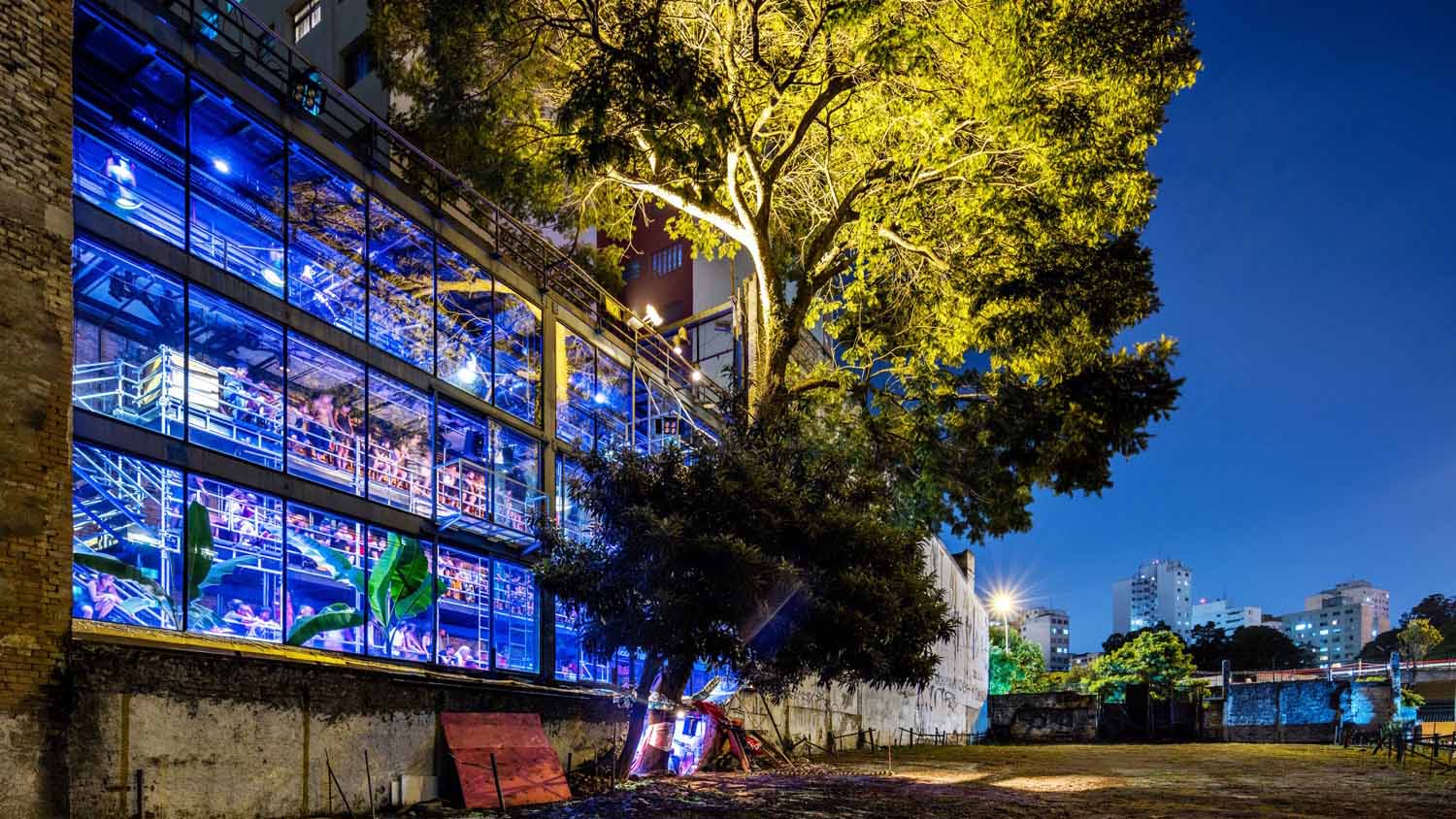
Their building (its latest version being designed by Lina Bo Bardi) brought us to tears when we visited it: not so much a fixed architectural arrangement, but rather an evolving, temporal extension of their artistic practice. A home in constant flux, held together by scaffolding poles and yet also one of the great pieces of theatre architecture in the world.
Emergent out of the territory they are situated in, Oficina have been central to resisting capitalist predation and accumulation in their predominantly Black neighbourhood of Bixiga. By understanding that today verticalization and real-state speculation means to the city what deforestation, plantations and mining mean to biomes such as the atlantic forest and rainforest, their 45-year resistance has led to the abandonment of a development of 30 floor towers on land adjacent to the theatre. Instead, the land has been expropriated by the state and will become a public park that will peel back the sedimented histories of the site, including the previously built over river.
Organised in collaboration with Scotland’s radical performance organisation Take Me Somewhere.
ReadBios
Fernanda Taddei (Rio de Janeiro, 1978), is an artist and actress, graduated in film studies, living in São Paulo and working in Teat(r)o Oficina since 2015. Mother of Lina, 8, and Vera, 5. Besides acting in several plays of the company, she works as a project conceiver and collaborator, and is a free, passionate researcher of Oficina’s language and history. Co-director, with Marília Piraju and Rodrigo Andreolli, of BORI – rite for black theatrical presentness and ancestry of Oficina. She is also an activist in the struggle for the Bixiga River Park and executive director of the Association Teat(r)o Oficina Uzyna Uzona.
Teat(r)o Oficina
Founded in 1958, Teat(r)o Oficina is the longest living theater company in Brasil. It has gone through different political and aesthetics contexts and proposed different researches and movements in theater performance. Its longevity is due to a strong sense of transmutation, a radical commitment to present local/world political scenarios at all times and the rooting of its building in the same address since 1961: Jaceguay street, 520, Bixiga neighbourhood, São Paulo. Its course, which involves hundreds of artists across decades, merges with the figure of José Celso Martinez Correa (1937-2023), one of the company’s founders and its director since the early 70s, who died after a tragic fire in his apartment. The singular relation, built throughout the years, between Oficina’s architecture and language made it listed as tangible and intangible Brazilian heritage. Its latest architecture project, designed by architect Lina Bo Bardi (1914-1992) and opened in 1993, results of her long lasting collaboration with the company, started back in 1969. The land around the theater’s building, which has been object of a 45 year long struggle of the company, with local politicians and neighbourhood alliances against real estate speculation, has finally been expropriated in 2024 to become a public park. the Bixiga River Park’s project will reopen part of Bixiga river’s course, which has been piped 4 meters underground for over a hundred years.