Links
Listen to Mazen Kerbaj on bandcamp
Lungless: without lungs, or the impossibility of breathing
Lungless: without lungs, or the impossibility of breathing
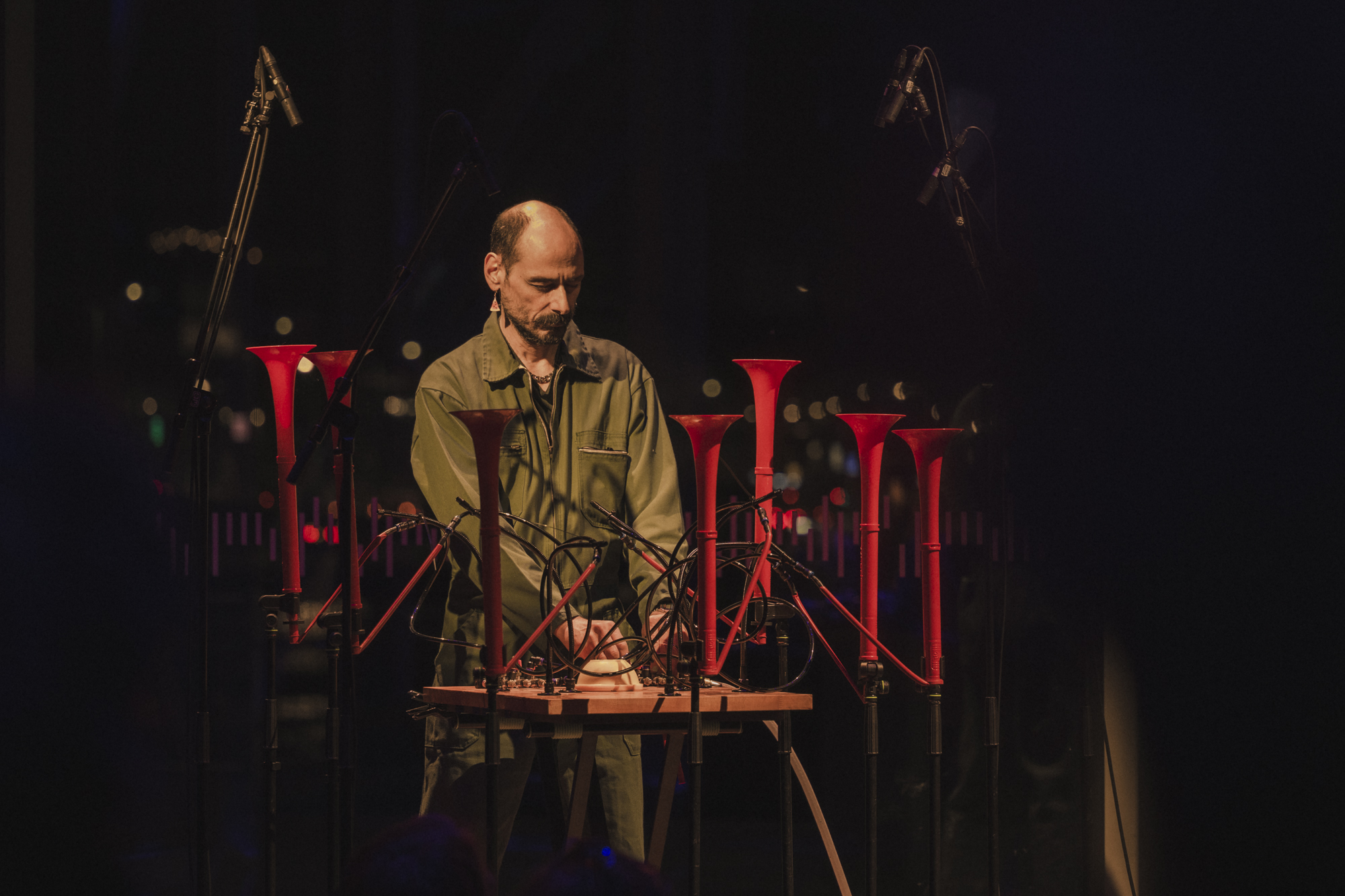
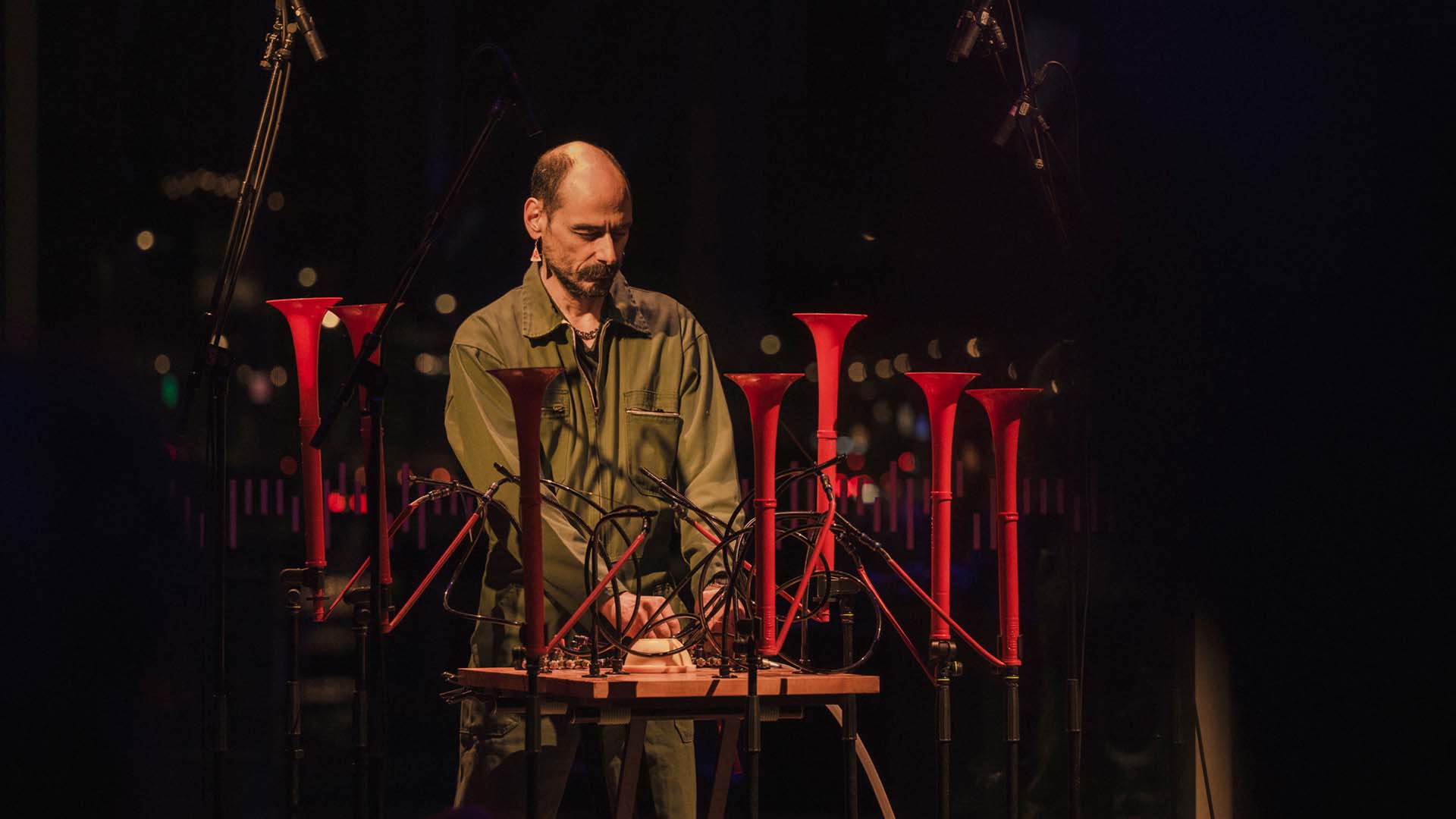
Where eliminatory violence denies the basic necessity of breathing, Lungless is a spatialised performance for the specially built “Putin’s Organ”—7 trumpets powered by an air compressor—giving voice to a trumpet without breath.
Overview
Mazen is one of Europe’s leading experimental musicians, who Counterflows have worked with multiple times. As a trumpeter, his primary physical material is breath. Growing up in Beirut during the civil war, living through multiple Israeli wars against the country and/ or Hezbollah, and in the solidarity of similar experience with the people of Palestine, he’s had many occasions to think about the basic necessity of breathing, and what it means to have that denied by force. In contrast to the documentary, field recording, compositional approach of Before The War… which he is presenting earlier in the evening, Lungless imagines a poetic response to war and genocide. How to give voice to the trumpet without breath?
Lungless is a composition developed for the “Putin’s Organ,” specially made for Mazen by the visual and sound artist Tarek Atoui and his studio. It consists of seven prepared trumpets that can be played simultaneously, connected to an air compressor. The instrument’s name evokes the Soviet World War II rocket launcher known as the “Stalin’s Organ,” whose destructive echoes resonate throughout historical and contemporary conflicts (they were widely used during the Lebanese Civil War). It also reinforces the meaning of the word “organ” in English, establishing a link both to the instrument’s mechanical function and to the human organ essential for respiration. We’re presenting a special spatial diffusion of Lungless at Tramway, with each of the seven trumpets discretely amplified in the room.
Context
One of the key influences on our thinking for this Episode has been the great Armenian-American Marxist historian Harry Harootunian, and his book The Unspoken as Heritage. The book does many incredible things, but most apposite here is how it addresses the ways in which collective and personal trauma often leads to silence; the tension between the need to be heard when some experiences are simply unspeakable. Harry finds a way to reconstruct some of those unspoken histories from his family’s experience of the Armenian Genocide. This compiling of historical traces and re-articulation of otherwise silenced testimony is a common theme within Episode 12. Equally important is the recognition that some things do just remain unspeakableunspoken. By manifesting this muteness in a material, physical, aesthetic and musical register, Lungless cuts against this seeming contradictionis the perfect example of this: a beating and rich cacophony that fluctuates between the individual (Mazen) and the many (7 trumpets): a common, insurgent voicing without speaking, that still sounds despite the denial of breath.
In the most recent edition of the Red Nation Podcast during a conversation with the Dakota writer and organiser Nick Estes, Lara Sheehi talks briefly about the link between breath and psyche in Arabic. As we understand it, the word for breath—Nafas (نَفَس)—and the one for self, soul, ego or psyche—Nafs (نَفْس)—share the exact same three-letter Semitic root (n-f-s). So in Arabic, there is a deep etymological bond between the physical act of breathing and the psyche. As Lara says, “we can start to think that if the practice of civilisation and white supremacy is one that is fundamentally dead set on severing ties, severing the tie between spirit, self, body, then breath becomes a centrepiece of that violence.” This reading reminds us similarly of the passage in pan-Africanist psychiatrist Frantz Fanon’s, A Dying Colonialism:
There is not occupation of territory on the one hand and independence of persons on the other. It is the country as a whole, its history, its daily pulsation that are contested, disfigured, in the hope of a final destruction. Under these conditions, the individual’s breathing is an observed, an occupied breathing. It is a combat breathing.
So perhaps while Lungless has a specifically poetic register, isn’t really an analogy at all: it (dis)embodies a modality of breath as psyche, soul and spirit, that persists even under the colonial duress of both physical and epistemic violence.
The music programme at Episode 12 has emerged as a collaboration with the UK’s best experimental music festival, Counterflows.
Content Notes: Loud noises.
ReadBios
Mazen Kerbaj is a Lebanese comics author, visual artist, and musician born in Beirut in 1975. He also works on selective illustration and design projects and has taught at the American University of Beirut. Kerbaj is the author of 15 books translated into more than ten languages and his work has been shown in galleries, museums and art fairs around the world. Mazen Kerbaj is widely considered as one of the initiators and key players of the Lebanese free improvisation and experimental music scene. As a trumpet player, he pushes the boundaries of the instrument beyond recognition.
Access
Live Stream
We will be Live Steaming most events. Watch them on the Episode 11 main page.
Check each Event’s page, or visit the Schedule (and filter for ‘Live Stream’) to see which events will be Live Streamed. The Live Stream will have a hosted chat function.
We’re trying out Live-Streaming with a dedicated multi-camera, editing and streaming crew: so it should look and sound legit, inspired by I wanna be with you everywhere.
It will be its own experience, different from, but complimentary to attending live, for anyone who can’t be with us in person for whatever reason—halfway between FOMO and JOMO.
more
Ear Defenders & Ear Plugs
Available on the door.
Content Notes
Loud noises.
See general Access information for Episode 12: From the Rivers to the Seas event