The We of revolutionary love
Houria Bouteldja
The practice of North African Indigenous revolutionary love, in the face of European capitalist violence and settler colonialism, with one of the most vital anti-colonial thinkers in Europe.
Arika have been creating events since 2001. The Archive is space to share the documentation of our work, over 600 events from the past 20 years. Browse the archive by event, artists and collections, explore using theme pairs, or use the index for a comprehensive overview.
The practice of North African Indigenous revolutionary love, in the face of European capitalist violence and settler colonialism, with one of the most vital anti-colonial thinkers in Europe.
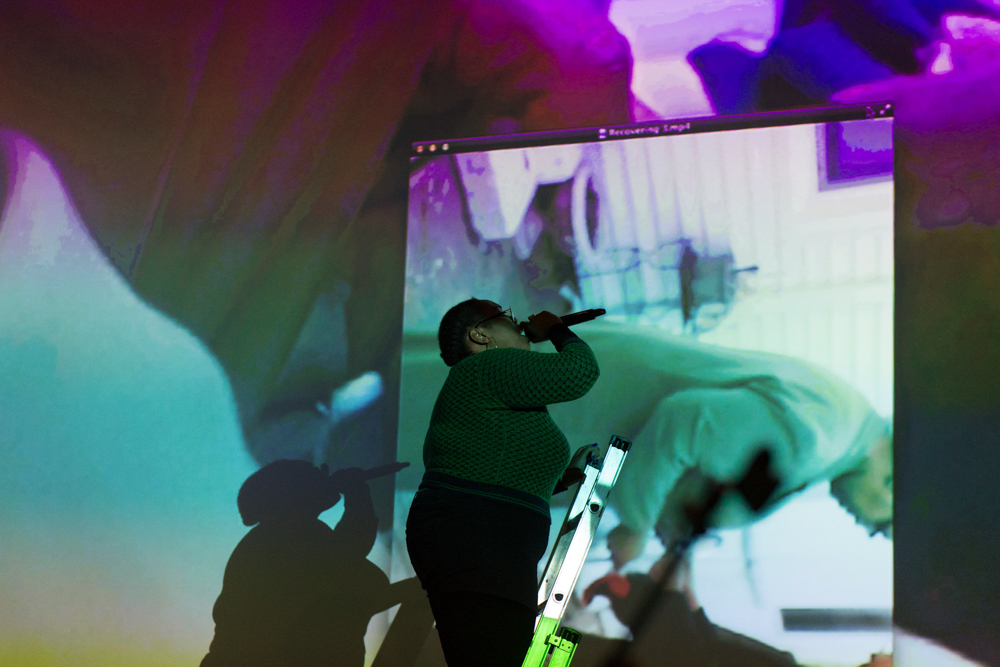
A sort of prayer and conference, a sort of scream and dialogue – a monologue and declaration at the time, addressing how we can build complicity with one another.
Tormented and drawn-out high-pitched yelps and drones, all interleaved with periods of torpid silence.
What is happening when systems of repression try to grasp communities’ ways of being, living or surviving, applying laws of sexuality, gender or race to cast them as criminal?
Real-time video feedback loops submerged in laminal sheets of sound soaked in gauzy timbral detail and multi-valenced, buzzing overtones.
A series of events organised by the Vogue’ology collective from the House Ballroom community in New York grounded in the scenes history of autonomous, self-organised struggle and a shared investment in collective art practices and how those intersect with the multiple and often divergent struggles for freedom.
The Tower performance at KYTN throws into that mix the 70’s fluxus light shows and films of Jeff Perkins and other filmic interventions tuned to their unique frequency.
Underground movement legend boychild hosts this workshop—on improvisation, cosmetics, movement and lip-sync.
An audio and video investigation of gender cults, Catholicism, hauntings and nuns’ use of audio devices…
A performed film lecture exploring how the ‘Rumberas’ of Caribbean cinema of the 40’s and 50’s subverted demeaning images of themselves through dance, sound and a sociality that insisted on blackness as being a cultural performance, not simply due to skin colour.
Shutter Interface is an expanded cinema piece: a series of machinegun bursts of chromatic relationships and visual harmonics in an overwhelming montage
“The miracle of Herman Melville is this: that a hundred years ago in Moby Dick…he painted a picture of the world in which we live, which is to this day unsurpassed.” – C. L. R. James