KYTN Salon: Post Consideration
Andrew Lampert Edwin Carels Eric La Casa John Harris Prof. Heike Sperling Zoe Irvine
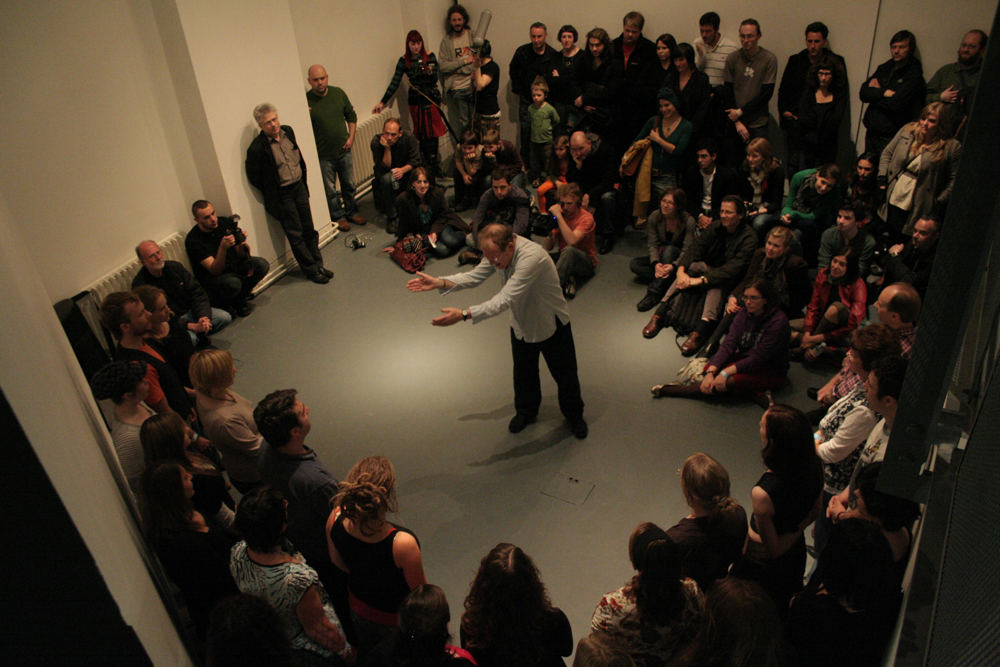
Post consideration and post rationalisation… How do we think about experimental music and film after the performance?
Arika have been creating events since 2001. The Archive is space to share the documentation of our work, over 600 events from the past 20 years. Browse the archive by event, artists and collections, explore using theme pairs, or use the index for a comprehensive overview.
Post consideration and post rationalisation… How do we think about experimental music and film after the performance?
John Mullarkey sets in a wider context our understanding of Alain Badiou and Francois Laruelle, two of the most radical philosophers in Europe today.
Hartmut is going to talk a little about his work at large and the politics of how his films are constructed. And we’ll screen one of his best films: B-52.
Lo-fidelity sheets of parinirvanic mangled tone get driven into oblivion by two longstanding gurus of the Northern England primitivist noise.
Journalist and underground music champion Alan Cummings talks to Keiji Haino about his career and his performance the previous evening.
Dub is strange. A conversation with Edward George and Dhanveer Brar.
A fully transcribed, described, and open-captioned film screening that’s nothing short of their actual open heart.
An immersive environment where sound is looped through oscillators, radio, guitar pick-ups and video amps to create dense strobing images and colours
Temporary Outpost for an Auditory Gesture is a kind of performed installation that explores how sonic phenomena (like feedback, vibration, resonance, echo, rhythm) condition our experience.
Formed as a means to realise William Bennett’s goal of “a sound that could bludgeon an audience into submission”
A performed, open, public conversation about how we might think politics from the position of intuition, in which Denise and Valentina use un-reasonable tools to map out a hybrid poetical/ ethical reading of their own situations.
A recorded a conversation that grounds the Episode, exploring Ailton Krenak’s thinking and distinct poetics of life; as it work against capitalism and fascism, as a denunciation of political alliances, and maybe even of ‘politics’.