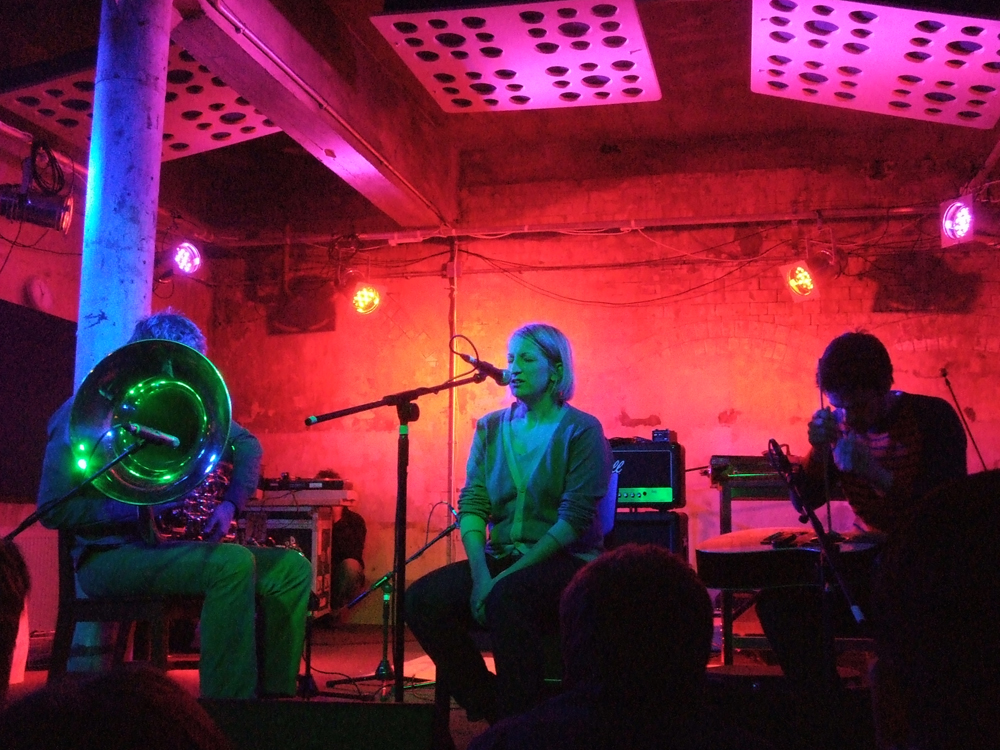
Neil Davidson, Aileen Campbell & Robin Hayward
Aileen Campbell Neil Davidson Robin Hayward
Sparse and miniature free thought workouts involving guitar, vocals and tuba.
Arika have been creating events since 2001. The Archive is space to share the documentation of our work, over 600 events from the past 20 years. Browse the archive by event, artists and collections, explore using theme pairs, or use the index for a comprehensive overview.
Sparse and miniature free thought workouts involving guitar, vocals and tuba.
Acting at the minimum. Each film here substitutes one small thing for another, (ironically) transforming received meanings by the simplest of actions; often kind of funny too.
This programme takes human subjects as the focus for sound and image construction. And it includes a couple of masterpieces of experimental film: Paul Sharits’ deeply empathetic interpretation of epilepsy and Peter Kubelka’s Webern inspired abstract portrait of Arnulf Rainer.
What’s the best way to spend time with a musician when they visit a city to perform? And when the musician in question has a great deal to say, what sort of concert do you organise to do justice to that?
Edinburgh. Sinewave manipulating Giant Tank-ette goes head-to-head with Decaer Pinga’s first lady of noise.
Out of a dark haze, shafts of lights are picked out from the surface of film. Out of the black silence, noise, audible scratches bloom into a bright drone of broken and cracked objects.
Nothing if not repetitive, film is founded on the incremental succession of minute difference. But how does repetition of the same play out, and is it a tool to comment on the standardising repetition of the mass media?
Profound mathematical ideas for romantics, to help us linger in the difference we share.
Quasi-theatrical multiple-projector pieces play with the relationship between performers, art and audiences.
A drone installation populated by flourescent strip lights working in complicity with analogue radios – “all the lights just do their thing”.
How can we imagine bodies not as an end in themselves, but as a medium through which we can become one another’s means?