Vorticity in the Eternal Hum
Alexander Moll Jackie Wang
What’s the relationship between the eternal hum of the oceanic beloved and the persistence of vorticity in fluid dynamics? And how does Alice Coltrane’s harp help us stay there?
Arika have been creating events since 2001. The Archive is space to share the documentation of our work, over 600 events from the past 20 years. Browse the archive by event, artists and collections, explore using theme pairs, or use the index for a comprehensive overview.
What’s the relationship between the eternal hum of the oceanic beloved and the persistence of vorticity in fluid dynamics? And how does Alice Coltrane’s harp help us stay there?
Ex Ganger guitarist’s solo performance for guitar and fx, featuring breathless processed guitar, complex in structure and melody.
An extravagant debauch of huge pianos, plush toys, cognac and ritual.
Sonic ‘observations’ of the world, through micro recordings on a tiny scale and transformed into something musically compelling.
Droner responsible for Fordell Research Unit, Muscletusk’s murk manipulator and Metzian concrete-mixer cement international relations and yr heids.
A programme looking at landscape, filmic or architectural spaces and at how the fixed stare of a camera frame only captures so much reality; here we focus on how filmmakers structure our relationship with that reality and at how they relate it to or interpret it through sound.
Dir: Maurizio Lazzarato & Angela Melitopoulos
A filmic constellation exploring Felix Guattari’s anti-patriarchal, anti-colonialist, anti-psychiatric, animist ideas of care and the self. And an Introduction to the Episode.
A performed installation by one of Germany’s most interesting visual artists, based on edited transcripts of the 1961 trial of Adolf Eichmann in Jerusalem and the writings of Hannah Arendt
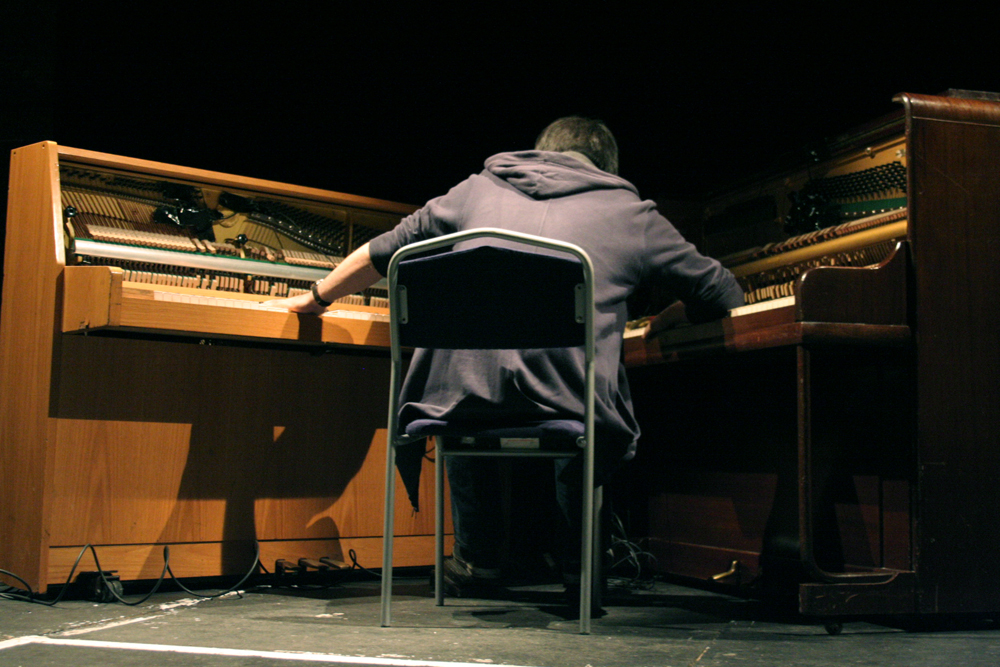
Sachiko’s very simple, pure sine tones and structures. Otomo on double pianos. Filament’s music isn’t composed and it isn’t improvised: it’s a hybrid of the two.
Voguing, drag, clubbing, and the politics of communities making different performances of gender and sexuality visible.
When we look, how do we objectify the body; how can we reflect on our (self) image as a construction?
A conversation between Philip and Moten: how do we read NourbeSe’s anti-narrative poetic lament in Glasgow today, given the city’s role in the history of slavery?