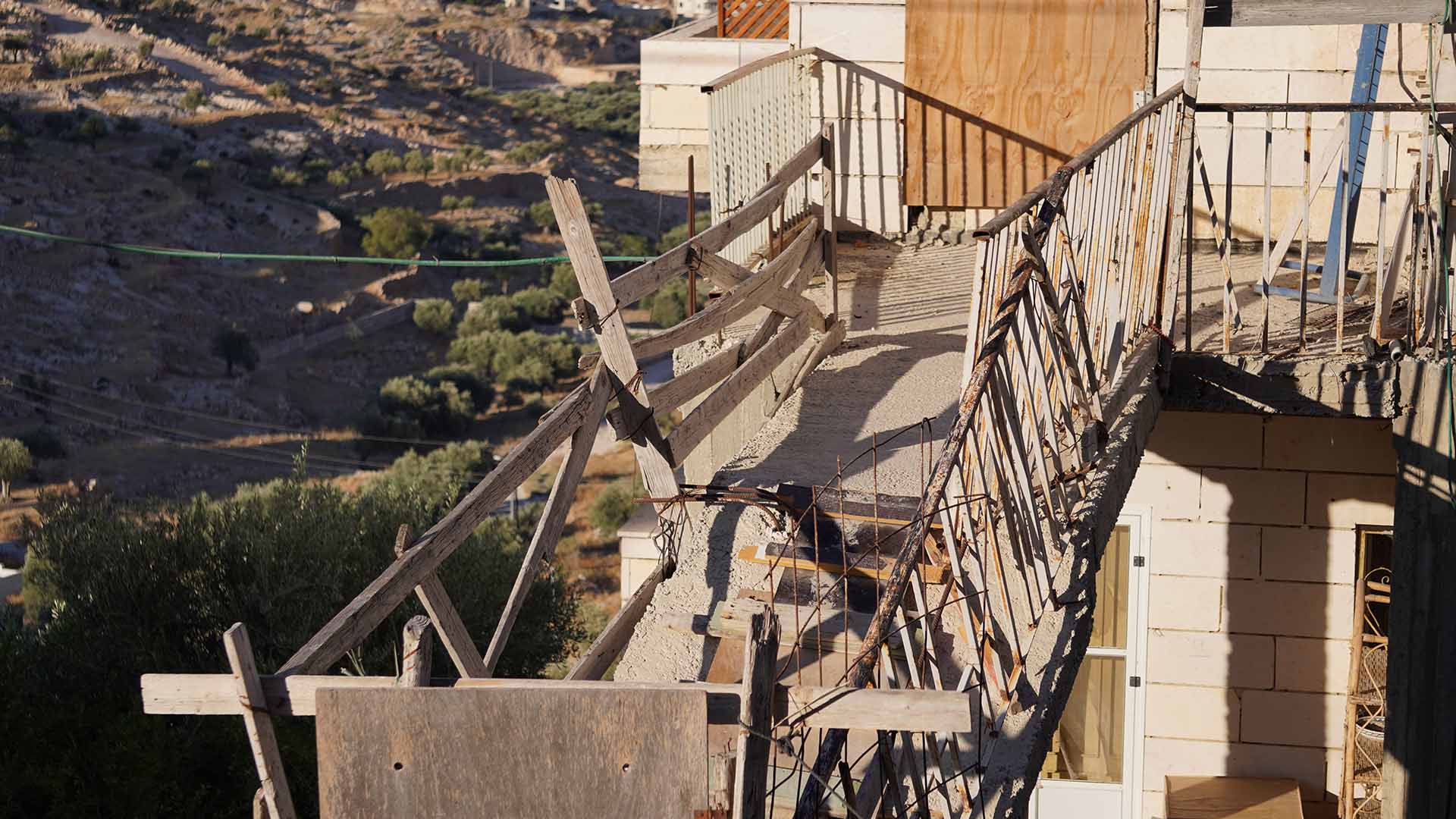
The Nakba in the Room
The Nakba in the Room
Where has art stood in the Nakba’s perpetration? The Nakba in the Room is a film whose form is part of a response and a search for an exit from complicity; improvised, wrestled and unmade in the same time of its viewing by two of the most brilliant film performance makers we’ve worked with.
Overview
Working with and between multiple insurgent communities and sites of resistance, Ayreen and Rene’s practice emerges out of a transcommunal weave of organising, writing, and assembling; of space, research and relationships. Within this constellation of processes, forms, the live ‘unmaking’ of films has emerged as a critical time-space for sharing sensations, perceptions and their thinking. We first presented one of these living film forms at Episode 1 in 2012. In them, they improvise, often with friends, with materials—both found and their own–live performance, text, gesture and sound. From a separate live video editing/ performance space (Tramway 4), the resulting film is broadcast as it is made/ unmade in real time to those assembled to view it (in Tramway 1).
The Nakba in the Room builds from their enacted film For Ever Gaza, at Episode 11; one of the most affecting, rigorous, genuinely experimental performances we have been lucky enough to present. It weaponised the tools of avant garde film towards justice and revolution in what Nate Mackey calls a ‘discrepant engagement’. Bring to the surface the contradictions and discrepancies between the perceived norms (in this case of an artworld complicit in genocide) and the insurgent sociality, worlds, and lives those norms deny or fail to take account of.
In their own words;
The Nakba in the Room
A few bodies enter a room. They begin by acknowledging the Nakba is there in that room and they try to understand, within the means of the cinematic space time, in the presence of other fleshly creatures, who have joined them, giving their time, energy, attention, to consider whether together, from where they are situated and in resistance to an ongoing genocide in Palestine, stretching across the region and the planet, they can rehearse the conditions for an art which can wrestle with and out of its complicities, imbrications in reproducing the genocidal culture futuring the Nakba.
Supporting notes from the artists:
– It is by now probably a known fact that the film which will be shared in Glasgow will be viewed by the public before the artists themselves will have seen it.
– The disactivation of the space of pre-view and pre-diction, is not intended to restore judgement to those who assemble to view the film, away from the self-appointed judges, but rather to abolish judgment all together.
– The sovereign police functions which preside over all the theaters of the Nakba are intimately bound up with governing our ways of seeing, thus also unseeing.
– A film fugitivity which searches for fugitive eyes and ears.
– How to abolish carceral art and the eyes, ears cultivated to recognize as expressions of beauty, novelty, pleasure, freedom the window dressing for the walls of the prison, the extermination camp or the new vestments of the colony’s managers, executors, executives.
– Thus, to say this film will be un/made in the time of its viewing is less a question of live-ness as form, as it is about searching for the forms of, toward the out-living. Living outside the dictates and confinements of the colony.
– It follows that what will transpire will be something beyond an improvisation; rather it will be closer to a wrestling match between the film’s animators, all the means of creating something, sometimes called film and all that pushes these means to reproduce the colony, reproduce the Nakba.
– Further still, in the context of what we are witness to, subjected to, … the Nakba, in all its devastation, including the genocidal denialist architectures, infrastructures it rests on…, to say that we are wrestling with something like cinema and the apparatus of cinema, is clearly not enough.
– It is in this context that we can say, what we attempt to wrestle with and out of is genocidal culture.
– Is there an art or a cinema that has not been touched by the Nakba? The Nakba in the Room is a film that begins by refusing to deny the obvious: we are indeed living in Nakba times.
– Furthermore, Nakba in the Room, in this context, begins by recognizing that art is, one could say has always been, in the center of the ongoing Nakba. In its enclosure, art as a weapon to carry it forward or in its disenclosure, as a means of opening up perception thus resistance to it, abolishing it, outliving it.
– To title this film, the Nakba in the Room, means to also try to open up a space time to perceive what it is, who it has implicated, who have been its protagonists, who have been its agents, who, what its objects, subjects, targeted victims. What have been its scopes and objectives.
– Nakba in the Room suggests that there is no place or space where Nakba has not played a part and it tries to suggest that wherever it isn’t being talked about, it is actively being armed, reproduced, perpetrated, futured.
– To share this notion in the context of sharing a film, is also to suggest that there is no art or culture that can escape confronting the horrors the Nakba has and will produce without the abolition of all that makes it continue.
– It means to ask questions which implicate most of what we have been shaped by in the fields of cultural and knowledge production.
– To begin most generally, we could ask, where has art stood in the Nakba’s perpetration?
– More materially and effectively, we could ask, what has been its function in the functions of the Nakba?
– More unthinkably and all the more necessary, in which ways did the cultures of ‘After Auschwitz’ or ‘Post-War’ help perpetrate, unsee, justify, legitimate the Nakba?
– How were the names and immense losses of millions under the hands of Nazis used to prolong and refashion fascism – to commit more genocide – to insist again on supremacy?
– Where stood and stands the cinema, philosophy, political theory, art which were bathed and baptized in those streams of consciousness or unconsciousness of a purported ‘after’ or ‘post’ … in the rubble of Gaza, in the unpeopled life worlds, cities, towns, camps, villages, neighborhoods, hospitals, holy sites, burial grounds, schools, knowledge centers, cultural centers, bombed, burned, demolished, flattened of Palestine, Artsakh, South Lebanon, Sudan, Syria, Ethiopia, Iran, Iraq, Somalia, Yemen, Congo, Libya, … ?
– What is the expanse geographically and temporally of the Nakba and how are we implicated in resisting or alternatively futuring it?
– The context of sharing this film is for a gathering acknowledging and trying to share the great weight that the people of Palestine and the wider region carry to reclaim, affirm, conjure other possible worlds: not only materializing the history of colonized, racialized, incarcerated, obliterated peoples across times, places, but also their steadfast, sumudic efforts to resist and outlive cultures founded on, shaped by, committed to ongoing genocide/denial.
– In this way, the film is not alone and it is searching for its friends, comrades. Its sense will grow as a gift grows in and through the memory, thinking, feeling, organizing of those who take it as a part of an ongoing transcommunal effort to abolish and delink from the forms of culture, politics, thought, art and life which have been engineered in the long durée of unaccounted for violence, structured legalized theft, abduction, obliteration of lives knowledges, worlds.
– Gaza is the necessary point of rupture between these very different trajectories of art, one which has served to cover up or provide cover for the Nakba and another which has attempted to survive, recover, heal from, perceive, resist, exit, abolish it.
– In this way Nakba in the Room is less a title for a film, or a single work and more a proposal, rehearsal and invitation toward how we may begin to see and struggle against our implicatedness within its cultures in our search to abolish the colonial futurity which it has been forged to impose.
– It could then be added that more than the sharing of a film, or the searching for how the Nakba is what remains the unspoken and unseen in the Room, what remains at the heart of this effort is the abolition of this planetary regime and the affirmation, contact with, reproduction of the outside which will be its undoing.
ReadBios
Ayreen Anastas, a body in search of gestures, words, phrases, sentences to disactivate and destitute the impositions, forms, including the form of biography this form of self, to bring about some forces which give potency to life to bodies with and around them. How to not separate one ‘self?’ from a common that helps shape life and gives it intensity and meaning. How to become unintelligible, incomprehensible, opaque to the fabricated machines of subjectivation and self-making. How to write in a language that only friends-to-come receive, a language that wrestles with language to keep the relations to all the palestines and to their forms of life alive.
Rene Gabri is another name for that process of recovering stolen life. The name is not gendered, though it has engendered enough confusion to assign to it all sorts of pronouns and prescriptions. It is a non-native name calling forth a native life, a life constantly pushed to the margins of oblivion. It recalls sites of previous and ongoing battles. It remains steadfastly associated with the wind, which is the closest kin or resembling a homeland. In this searching, a question which re-emerges: is wind origin, destiny or the unforeseen push toward a dissemination of the seeds of whatever could become recovery.
Access
Live Captions
Content Notes
This is an improvised video performance which may make use of archival and found footage, including documentation of war zones and sites of genocidal violence. Some of the imagery may be upsetting or disturbing. Possible instances of strobing lights, blackout, and loud noises.
See general Access information for Episode 12: From the Rivers to the Seas event
Artists

Rene Gabri
