J’ai Huit Ans
J’ai Huit Ans
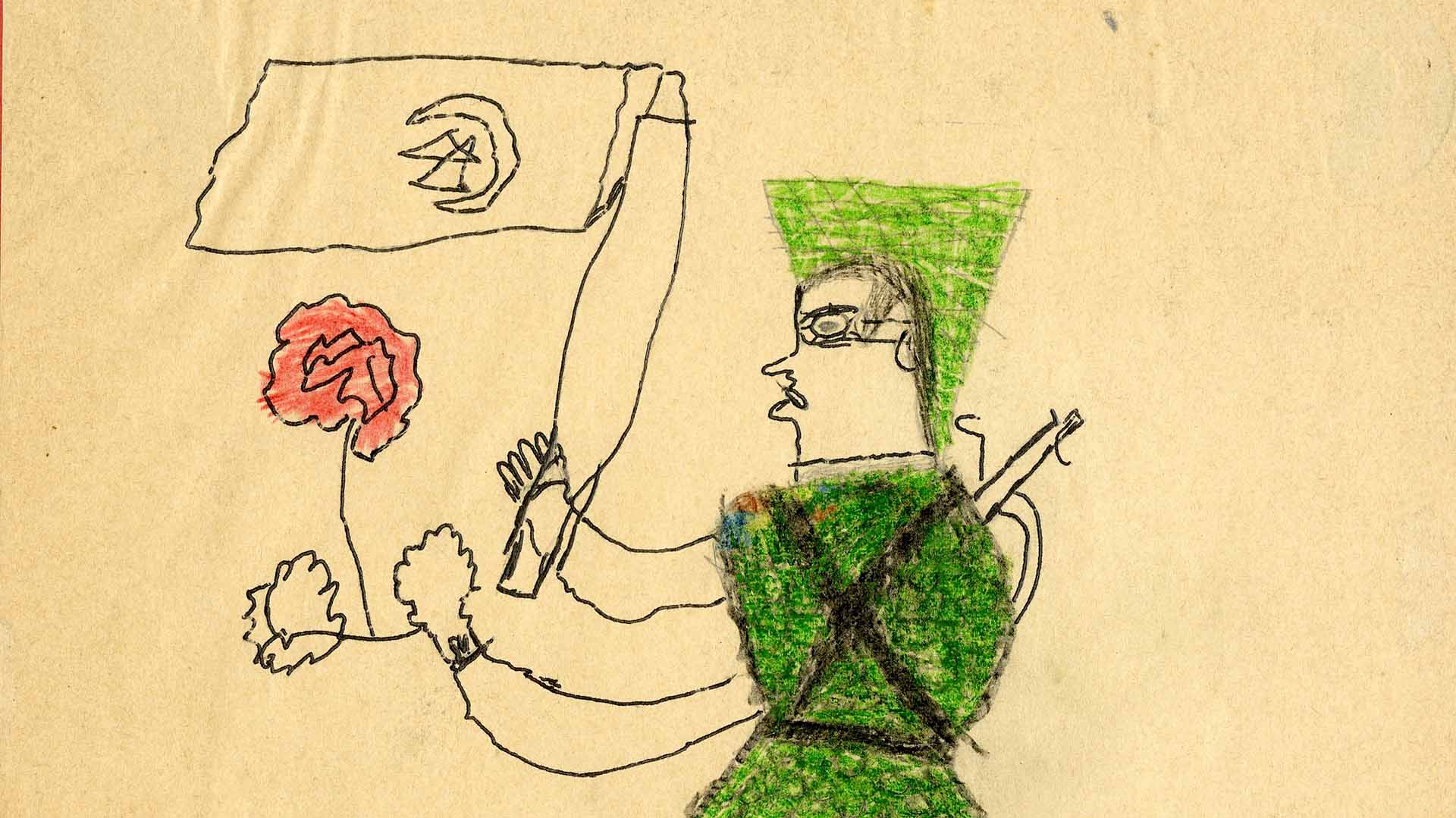
A landmark of militant cinema, J’ai Huit Ans emerged from work undertaken by the great anti-colonial psychiatrist and philosopher Franz Fanon with Algerian child refugees, documenting their experiences of French violence during the Algerian War of Independence. Filmed portraits of these children are intercut with their drawings, originally collected by Fanon, as they narrate the stories behind the images.
The film will be introduced by visual culture theorist, Nick Mirzoeff, who was among the first people to write about this film in English. You can read his analysis here.
J’ai Huit Ans will be screened between two conversations with Nadera Shalhoub-Kervorkian. The film speaks to her notion of unchilding, which will feature in her chat with Lara Sheehi later in the evening.
Overview
In 1961, in a children’s house for refugees in Tunis, the great anti-colonial psychiatrist and philosopher Franz Fanon—experimenting with new clinical approaches—encouraged children to draw their experiences of the Algerian War of Independence. These images, the children’s narration of them and filmed portraits make up the J’ai Huit Ans. Made when the war of liberation was also eight years old, the film memorializes the war as well as the children seen in it. Banned by the French state, it continued to circulate clandestinely among communist networks.
Context
“Mournfulness makes the mourner mute” is how Walter Benjamin described the silence that often follows trauma. By folding drawing into the therapeutic relationship Fanon opens a space for unspeakable experiences to be narrated by first being sketched.
Houria Bouteldja will speak on Saturday about the end of European/white innocence. This innocence has been maintained through an ongoing denialism of the West’s colonialism; often hidden behind arguments over evidence or quantitative measure. Have enough people been killed for something to qualify as a genocide? And if not, can the crimes be downgraded, dismissed, forgotten? J’ai Huit Ans is a vital refocusing on the everyday and the power of testimony, on individual memories and emotions that are potentially truer than any statistical analysis or disputed grand narrative that erase the experiences of ordinary victims. While in France a great effort was made to deny the colonial atrocities of the war, they were well known to the young people of Algeria. The film rejects that denial. As the great Marxist historian Harry Harootunian has written, “Genocidal events are never a matter of historical judgment but rather a matter for the dead. The nameless tell us what happened and that is all the evidence we need.”
The combination of the children’s portraits, testimony and drawings in J’ai Huit Ans create a multi layered and unique depiction of state violence which can be hard to watch. But as Lara Sheehi writes in the introduction to From The Clinics To The Streets, there is an ethical need to “keep track of—be aware of, note, recognize, attune to—what it feels like to not immediately, at least, reach for the escape hatches that dislocate, dismember, and dissociate us from the pain and suffering in which we must be implicated if we are to usher in revolutionary futures.”
There is a term for the process by which children serve as political capital in the hands of the colonising state. This word is ‘unchilding’ and it was coined by Nadera Shalhoub-Kervorkian to name the political work of violence designed to create, direct, govern, transform, and construct colonized children as dangerous, racialized others, enabling their eviction from the realm of childhood itself. The children in J’ai Huit Ans speak directly to this violence, and their testimony, and even the title of the film, insist on their status as children.
While under arrest in France in the 60’s, Paul Vergès—leader of the Reunion Communist Party and Françoise Vergès’ father—saw J’ai Huit Ans, and invited Yann Le Masson to film the first of three incredible militant cinema documentaries about Reunionese resistance to French colonialism. Françoise will show these restored films, banned for decades, and in conversation with Lara Sheehi, talk through their importance on Friday evening at the Episode.
There is something to be paid attention to in the quality and context of these drawings. Made outwith an artistic situation, maybe even before drawing was established as a valid tool in psychiatry, they seem less like art and more like having emanated from the aesthetic registers of a shared sociality. A visual practice unrecuperated into an art world complicit with the European colonial project, they instead hold it to account.
Note: Authorship of the film seems contested and a little complex to understand, but involved being conceived by René Vautier; using drawings collected by Fanon; portraits filmed, additional testimony recorded and the whole film conceptualised and edited together by Yann Le Masson and Olga Poliakoff.
Collections La Cinémathèque de Toulouse
Content Notes
Descriptions and drawn representations of colonial violence against children and their families, from the children’s own perspective.
ReadBios
Yann Le Masson (1930 – 2012). The son of a naval officer, he spent his youth in various ports (Brest, Vannes, Toulon, Dakar). He studied mathematics and electrical engineering, then entered the Louis Lumière film school (1953) and finally IDHEC (graduating as a cinematographer for short films, 1955).
Mobilized for the Algerian War, he served as a paratrooper officer from August 1955 to April 1958. Traumatized by the conflict, he decided to use cinema to fight against colonial wars J’ai Huit Ans, (1962) and to support the FLN. A politically engaged filmmaker, he directed about ten documentaries, including Sure Amer, (1963), Kashima Paradise, (1971, co-directed with Bénédicte Deswarte), and Regarde, elle a les yeux grands ouverts (1980).
He simultaneously pursued a career as a renowned camera operator and cinematographer (1955-1993). In 1975, he joined Le Grain de sable, a politically engaged production group, and participated in the reopening of the Cinéma Saint-Séverin in Paris’s 5th arrondissement (1980-1984). In 1980, he became a professional river transporter in Europe on the barge Nistader to prepare a film ( Déchirage ). Upon retiring in 1993, his barge, moored in Avignon, remained his primary residence. He also taught film at the INA and IDHEC (1977-79); at ESAV (Toulouse), ESRA (Nice), and EICTV (Cuba) (1992-2002).
Nicholas Mirzoeff is Professor and chair of the Department of Media, Culture and Communication.
Among the founders of the interdisciplinary practice of visual culture, he has published more than a dozen books and many articles. His most recent book is To See In The Dark: Palestine and Visual Activism Since October 7th (Pluto, 2025), which is the subject of a dossier at Social Text journal. It has now appeared in Italian and Spanish translations.
In 2023, he published White Sight: Visual Politics and Practices of Whiteness (MIT Press), also available in Italian and Spanish translations. and An Introduction to Visual Culture (Third edition, Routledge). How To See The World was published by Pelican in the UK (2015) and by Basic Books in the US (2016). It has been translated into eleven languages and was a New Scientist Top Ten Book of the Year for 2015. His book The Right to Look: A Counterhistory of Visuality (2011) won the Anne Friedberg Award for Innovative Scholarship from the Society of Cinema and Media Studies in 2013.
A frequent blogger and writer, his work has appeared in The Nation, Hyperallergic, Frieze, the New York Times, the Guardian, Time and The New Republic.
Access
English Subtitles
Content Notes
Descriptions and drawn representations of colonial violence against children and their families, from the children’s own perspective.
See general Access information for Episode 12: From the Rivers to the Seas event