Touching the Future
Touching the Future
Collaborative Project with John Lee Clark, Soline Vennetier, Issy McGrath, Lisa van der Mark, Gabrielle Hodge, Kyle Bettley and Jordan Goldman
Touching the Future – Words by Gabrielle Hodge
About Touching the Future
Touching the Future was a series of Protactile training and social events hosted in Central Glasgow in April 2026 which aimed to kickstart the Protactile movement in Scotland. Protactile is an emerging system of tactile communication developed within DeafBlind communities in the US that builds on contact space, tactile imagery, and reciprocity to promote autonomy and equality for DeafBlind people.
Creating Touching the Future
The project came about due to a fortuitous meeting between Isabelle McGrath, a Scottish DeafBlind teacher, leader and activist, and the main promoter of Protactile in Scotland, and Dr Gabrielle Hodge, a sighted Deaf linguist at the University of Edinburgh in late 2024. We secured funding to bring Protactile experts John Lee Clark (USA), Dr Soline Vennetier (France) and Lisa van der Mark (The Netherlands) to Scotland. Jordan Goldman, a Canadian Co-Navigator, and Kyle Bettley, a Scottish Co-Navigator, also joined in this endeavour. Touching the Future was funded by the University of Edinburgh, the REALITIES Consortium, and Creative Scotland, with support from Arika.
The Touching the Future team worked with Barry Esson, Emma McLeod, Siobhan Carroll, Cloudberry MacLean and Nosheen Khwaja from Arika to host these events. Together we created immersive spaces in Glasgow within which DeafBlind people could meet and create new Protactile knowledge about their worlds and to later share these with other DeafBlind people around the UK.
Before Touching the Future
We anticipated that our DeafBlind guests would benefit from the time and space for exploring, understanding and growing their Protactile language needs with creativity and joy. We also hoped this opportunity might provide a catalyst for the emergence of Protactile in Scotland and the UK, where there is a huge demand for Protactile but not yet much successful financial support for it. Indeed, in many quarters the resistance is ideological: lots of sighted people simply don’t want DeafBlind people to have agency, in the sense of being able to move around as wanted, touching everything. Yet how are we to have agency without touching our environments? “One thing we wanted to do,” Clark said, “is to create a space for us to fumble around in without sighted people swooping in to be unhelpfully helpful.” The central questions asked during Touching the Future were: What does beautiful, clear communication feel like for tactile-oriented people? How can we move through the world as confident tactile people? How can we decide for ourselves what to do in everyday situations that present challenges specific to DeafBlind people? We hoped that by providing the time and space for DeafBlind people to explore such questions on their own terms, the Protactile movement could be gently seeded in Scotland and eventually, the UK.
While Touching the Future
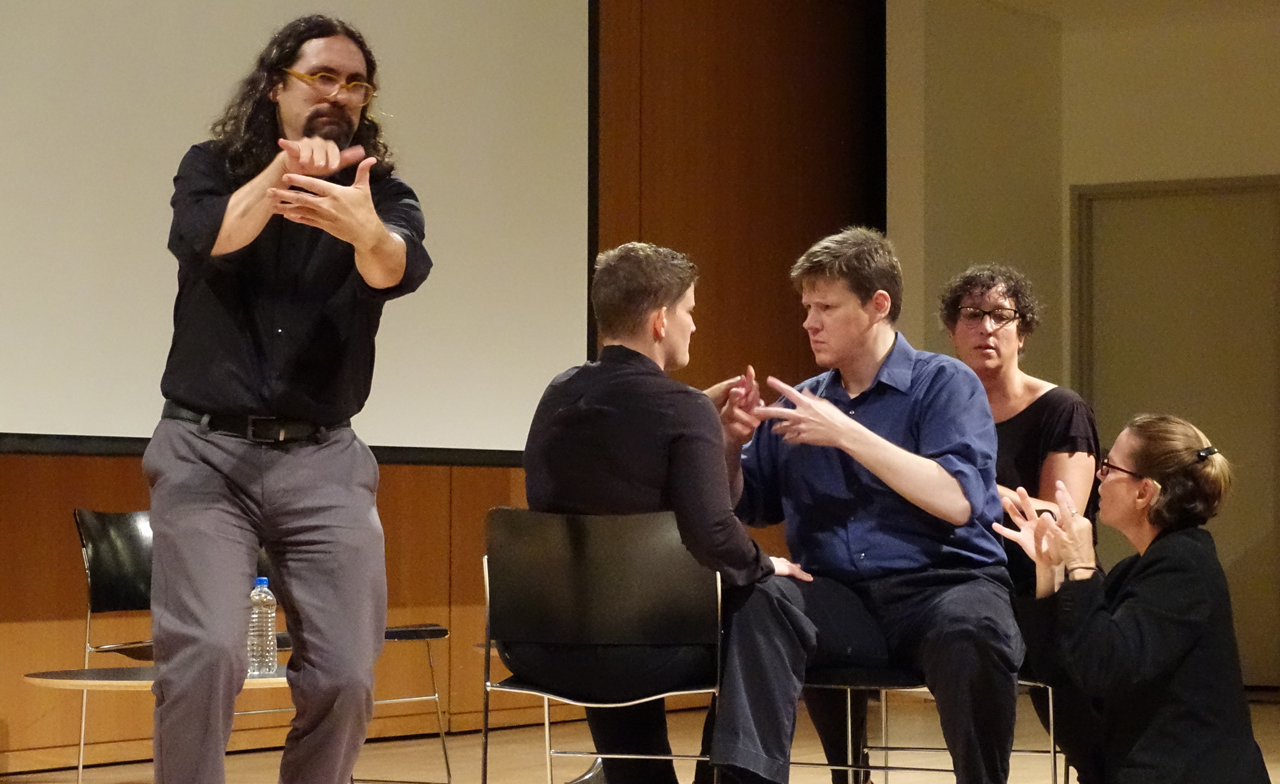
Three DeafBlind trainers led DeafBlind, Deaf and hearing students through four Protactile events from 15-22 April 2026. We hosted Immersion, a one-week residency for one Scottish DeafBlind trainee, one Scottish hearing trainee, and one Australian Deaf trainee. This made it easier for us to learn Protactile in a familiar and life-affirming environment, at home. On Saturday 18 April, we hosted Taster, a one-day intensive for four more DeafBlind people from Scotland and England, at Civic House, which is an old printing press turned into a contemporary community space. On Sunday 19 April, we hosted a larger event Gather for an additional eighteen DeafBlind people, including from Wales and Northern Ireland. These training events concluded with Celebrate, an open night social on Sunday 19 April for another 25 Protactile-curious people, including Deaf, Blind and sighted hearing people, including many from abroad.
During each event, we roamed around engaging in anything from loose casual interactions to more structured lessons involving conversations, games, tactile exploration and fumbling with different objects. We started the project local and small with Immersion, then expanded out into the world with Taster, Gather and Celebrate, growing in number as more people received some Protactile training and exposure. In total, 28 DeafBlind people directly engaged and benefited from the project. We also engaged with an additional 25 Deaf, Blind or Vision Impaired and sighted hearing people during the final Celebrate event. All events were held in the Woodlands area of central Glasgow.
After Touching the Future
After Touching the Future, we were buzzing with excitement and inspiration, as well as flagging with fatigue. There are four key insights we’d like to share.
Firstly and as expected, Protactile is life-changing for DeafBlind and sighted people alike. No wonder people are hungry for it! Some quotes offered by our DeafBlind guests attest to what we achieved. Ben Fletcher shared that “Protactile gave me something I rarely experience as a deafblind person: direct knowing instead of constant guesswork…Protactile changed touch from something functional into something rich, social, expressive, and genuinely liberating…For the first time, I was not piecing the world together from fragments. I was meeting it directly, through touch.” Another guest shared that “Protactile transformed space from something stressful that I have to manage with poor vision into something I could physically share, turning navigation into connection and communication into a fully embodied experience.”
Secondly, Protactile will need time, patience and attention to take hold in Scotland and the UK. As Protactile is based on touch, contact space and reciprocity, it grows and evolves when people are in close physical proximity to each other and able to learn and practice together. DeafBlind people in the UK will need physical spaces to evolve the language on their own terms, without other people rushing to formalise these early practices into policy, which can come later after there has been enough development. Any policy relating to Protactile must be driven and led by the DeafBlind people using and growing this language personally.
Thirdly, Protactile can take hold in new spaces that also contain sighted Deaf and hearing people. The experienced DeafBlind Protactile trainers were surprised to find that Protactile could flourish here even in mixed DeafBlind/sighted training environments, as US training usually occurs in DeafBlind-only spaces. These DeafBlind-only spaces are incredibly important and valuable, but they were not yet totally possible in the UK at the time of this first project. It is heartening to know we can host mixed groups because this is more reflective of UK demographics and numbers of DeafBlind people able to congregate in different areas, while also working to create DeafBlind-only spaces now that we have more DeafBlind people involved who are keen to pursue Protactile more deeply.
Finally, with DeafBlind people leading the team, we forged a strong and respectful working manner that produced four fantastic DeafBlind-led social events. We are determined to work together again, and will certainly be applying for grants to further the project into 2027 and beyond. We also identified key DeafBlind members of the community who can play a vital role in the driving use of Protactile in the UK going forward, in addition to many other people who simply want to use it in their everyday lives.
Acknowledgements
The Touching the Future team are grateful to all the DeafBlind people and other guests who joined us in Glasgow from near and far. We are also indebted to Barry, Emma, Siobhan, Cloudberry and Nosheen from Arika for their constant, unwavering support and experienced advice, and to Hazel McKillop from Civic House for her calm and helpful presence during Taster, Gather and Celebrate.
Contact
Are you interested in experiencing Protactile in Scotland? You are welcome to reach out to us by email: protactilescotland at gmail dot com
Artists